
|
Early Color Television How Many RCA CT-100s Were Made and Sold?
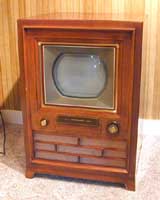
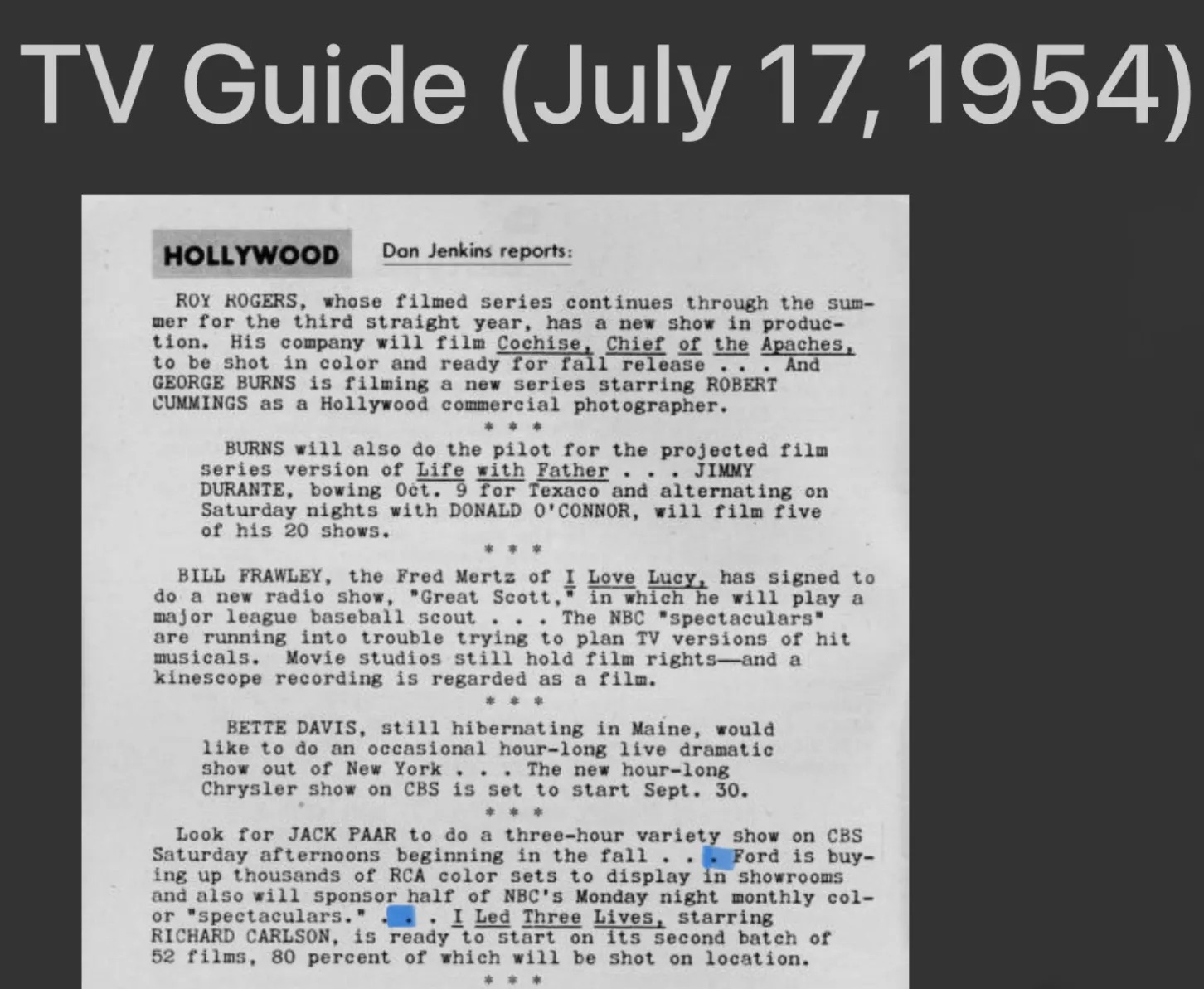
Marshall Wozniak has researched the production and sales of the CT- 100. Here is his summary: After the termination of production of the RCA 15GP22 in May, 1954, RCA had a plan to dispose of their excess inventory of approximately 3800-4000 CT-100’s (only 200 had been sold up to May, 1954 according to RETMA) by selling them to Ford to use in their showrooms. The plan was the CT-100 sets would display Ford’s sponsored monthly Monday night “Spectaculars”. This TV GUIDE article talks about it briefly and I found other articles describing the sale plan to Ford. The inventory sale did not go through because Ford ultimately rejected the idea. Sources: RETMA and Television Digest. I found that RCA donated CT-100 sets to technical collages and the color industry. And remembering the 19 inch color sets from Motorola, Raytheon, Westinghouse and Admiral were just becoming available beginning June, 1954. The industry essentially declared the 15 inch color tube dead. For this reason, I believe it’s not correct to say RCA “sold 4000 CT-100’s.”
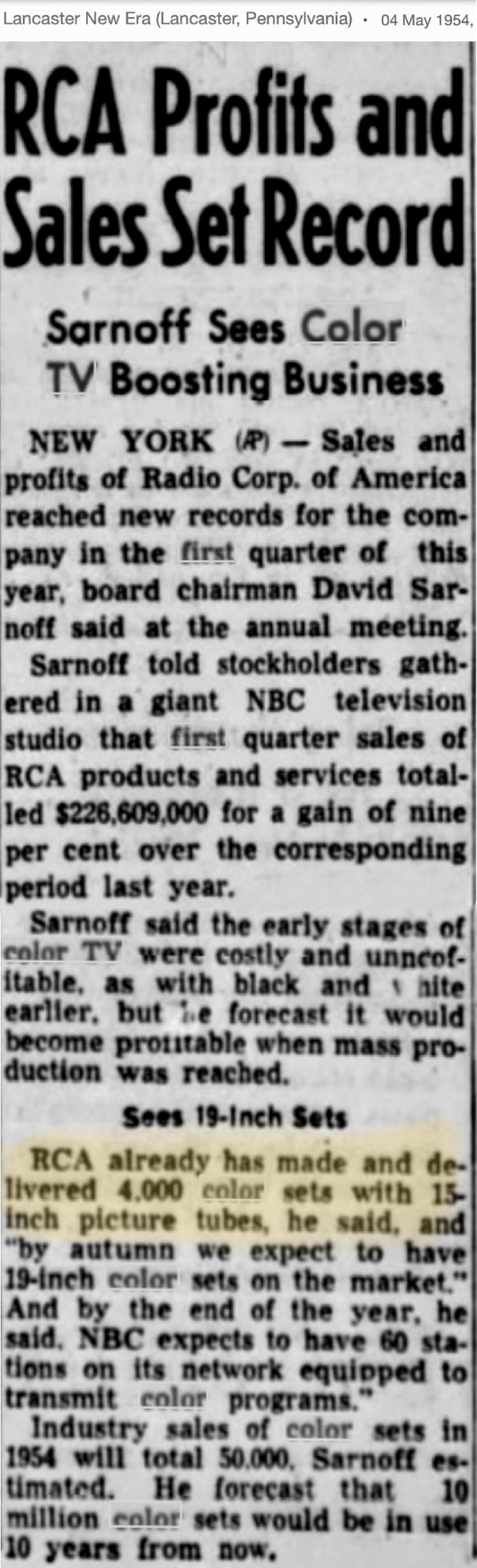
May, 1954 Behind The Scene. Shortly after Snaroff’s above announcement of 4000 CT-100 color sets delivered, (but few sold) RCA quietly announced the end of 15GP22 production in May, 1954, which indicates production of the CT-100 stopped about the same time. The RCA CT-100 had a short two month production run, March 25, 1954 to May, 1954. An excerpt from a 1968 court case follows. “Columbia Broadcasting Sys. v. Sylvania Electric Prod. United States District Court, D. Massachusetts Dec 23, 1968 294 F. Supp. 468 (D. Mass. 1968) “51 In May, 1954, RCA announced that it would no longer take orders for either the 15-inch 15GP22 or (the 19-inch tube, never to go into commercial production), an event which marked its discontinuance of shadow-mask tubes of the planar configuration. *476” Author note: The RCA 19 inch color tube never went into production because of the introduction of the superior CBS Hytron color 19 inch tube. The RCA 19 inch receiver had not been released, so RCA cancelled the 19 inch project and launched a crash program to develop what we know now as the 21AXP22 CRT as part of the 21CT55 color receiver and released to dealer showrooms in December, 1954. You may find it interesting that RCA purchased a CBS color patent license so it could incorporate the new CBS technology in their upcoming 21AXP22.
|