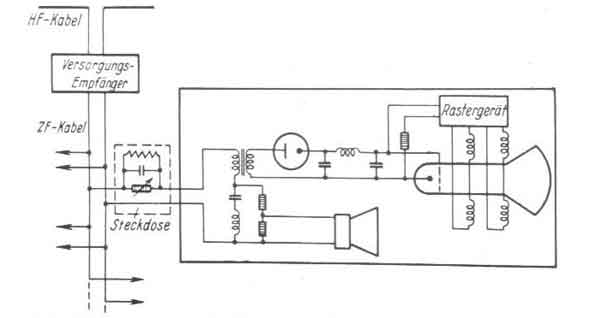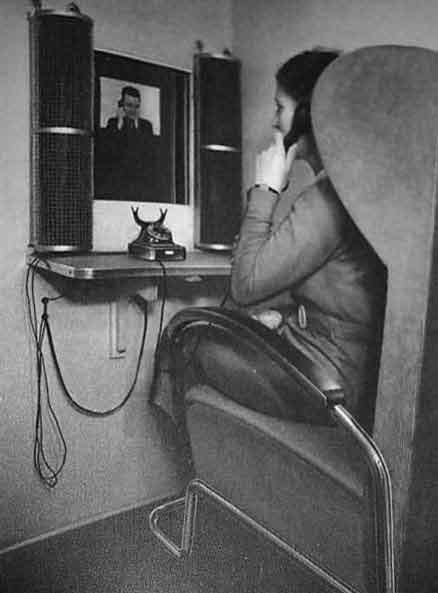

Early Electronic Television Telefunken "Blockfernseher"The Blockfernseher was a television receiver without a VHF tuner. In the 1930s the German post office (Deutsche Reichspost) developed a wired television system (Fernseh-Drahtfunk). Wire transmission was used for television in the public viewing rooms (Fernsehstuben) in Berlin. Wired distribution was chosen over broadcast to eliminate interference from electrical machinery, etc. The diagram below shows the video being distributed over a high frequency cable to public viewing rooms at a 4.2 mHz carrier frequency (to allow long distance transmission). Audio was sent at 315 kHz or on a separate cable. At the public viewing areas, the video signal was up converted to the TV set's IF frequency of 8.4 mHz. The signal was applied to the first IF amplifier. Within each receiver, the synchronizing signals were extracted. The First attempts using cable transmission were made in 1936 with the 180 line television system and the carrier frequency was 1.3 MHz. The telephone network was used to transmit the video. Bild 97 on p. 339 shows the actual cable network in Berlin in 1942. Additional cables were installed between Berlin and Hamburg, Munich and Vienna. These cables also were used for picture telephony between Berlin and Leipzig, and other cities in Germany. Television signals broadcast over the air could be used for position finding by the allied bombers, so broadcasting was cancelled during the war. Distribution of television by cable continued during the war, into the public viewing halls and hospitals for wounded soldiers. This article describes the entire system: Article and information courtesy of Eckhard Etzold
|