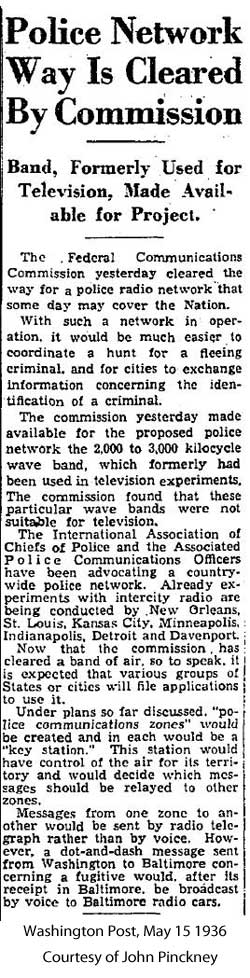

Mechanical Television Mechanical TelevisionThe concept of scanning a picture using mechanical means was first proposed by Alexander Bain in 1843. The scanning disk, which became the basis of mechanical TV, was proposed in 1884 by Paul Nipkow. At that time, vacuum tubes and photoelectric cells needed to make a television system didn't exist. The first mechanical television systems that produced real television images were developed by John Logie Baird in England and by Charles Francis Jenkins in the U.S. in the mid 20s. Broadcasting began in the United States on the AM radio band (550-1500 kHz). In 1930, the Federal Radio Commission allocated channels in the 2 mHz band for experimental television transmission to allow higher resolution (45 and 60 line pictures) to be transmitted. Picture quality was very poor, and the screens were only an inch or so wide and were usually made up of only 30 to 60 lines (compared to 525 lines in the present U.S. system). Most of these sets used a motor to rotate a metal disk to produce the picture, with a neon tube behind the disk to provide the light. Later mechanical systems used the lens disk, mirror screw and mirror drum. The Scophony system was the only mechanical system capable of high definition pictures, but it was developed at a time when the cathode ray tube had already been demonstrated as a better method of displaying television pictures. By 1931, television was being broadcast from about 25 stations in the U.S., not only from the major cities such as New York and Boston, but also from Iowa and Kansas. Several manufacturers were selling sets and kits. he frequencies used for TV broadcasting at that time could travel long distances, so reception was possible hundreds of miles from the station. However, the pictures suffered from not only poor resolution, but also fading and ghosting. In Columbus, Ohio, Murray Mercier, born in 1912, was one of the first people to watch television. Here is his story. In England, regularly scheduled 30 line television programming was first broadcast by the BBC in September of 1929 using equipment supplied by John Logie Baird. At first, only the picture was transmitted for a few hours a week, after regular radio broadcasting was completed for the day. By March of 1930, sound and pictures were transmitted together. In 1933 Baird built a studio at the Crystal Palace. Most countries in Europe had at least one mechanical station, and there were stations in Japan and Australia. Here is a History of Early Television in Germany, by Wolfgang Lill. Because of the poor picture quality, mechanical television was not a success. By 1933 almost all stations were off the air in the United States, and in 1936 the 2 mHz television band was reassigned for police use. Mechanical television transmission by the BBC continued until 1935, and in the Soviet Union until 1937. More on Mechanical Television
|