Early Electronic Television
RCA's Television Field Trials and Stations W2XF/W2XK/W2XBS/WNBT
1928-29 Mechanical
Experiments
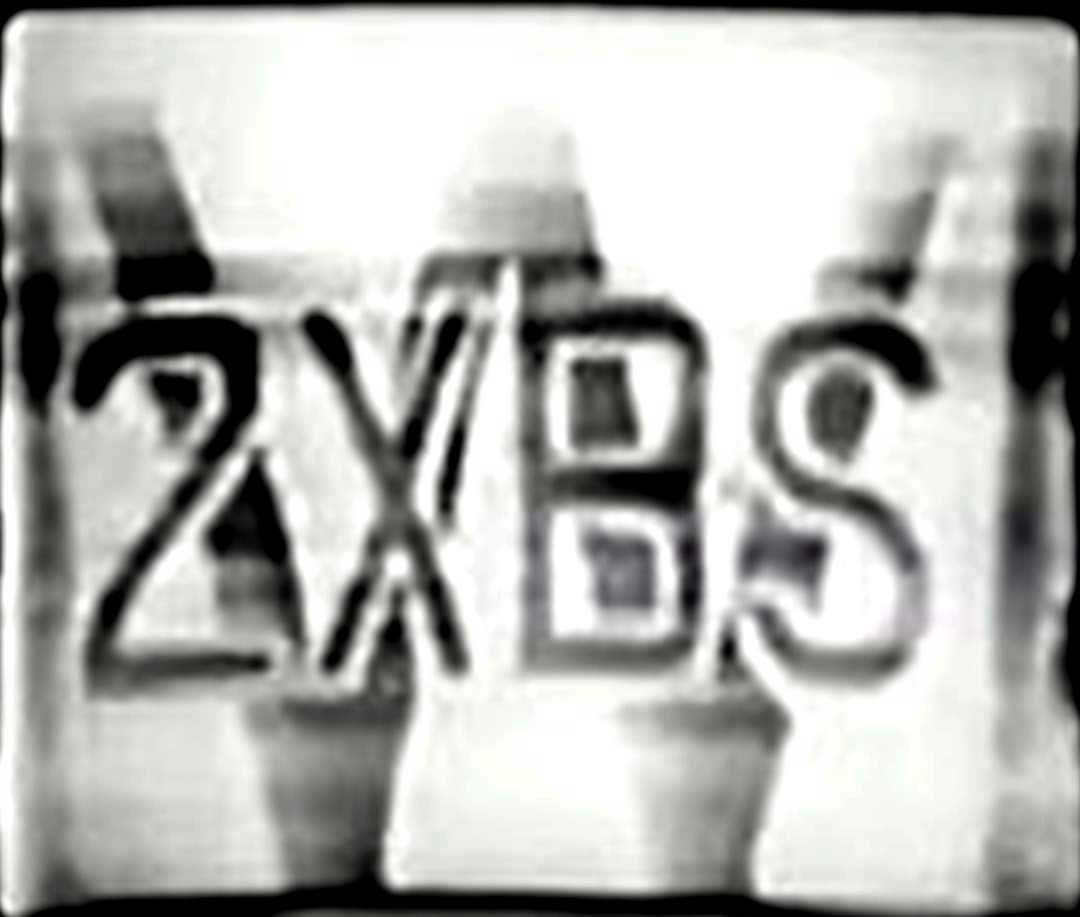
RCA's first experimental television transmissions began in 1928 by station
W2XBS New York in Van Cortlandt Park and then moved to the New Amsterdam
Theater Building, transmitting 60 line pictures in the new 2-3 mHz band
allocated to television. A 13" Felix the Cat figure made of paper mache
was placed on a record player turntable and was broadcast using a
mechanical scanning disk to a scanning disk receiver. The image
received was only 2 inches tall, and the broadcasts lasted about 2 hours
per day. By 1931 the station became part of NBC and began to transmit from
42nd St. These early broadcasts consisted of objects like Felix the Cat or
early test patterns and photographs. The RCA receiver in our collection was
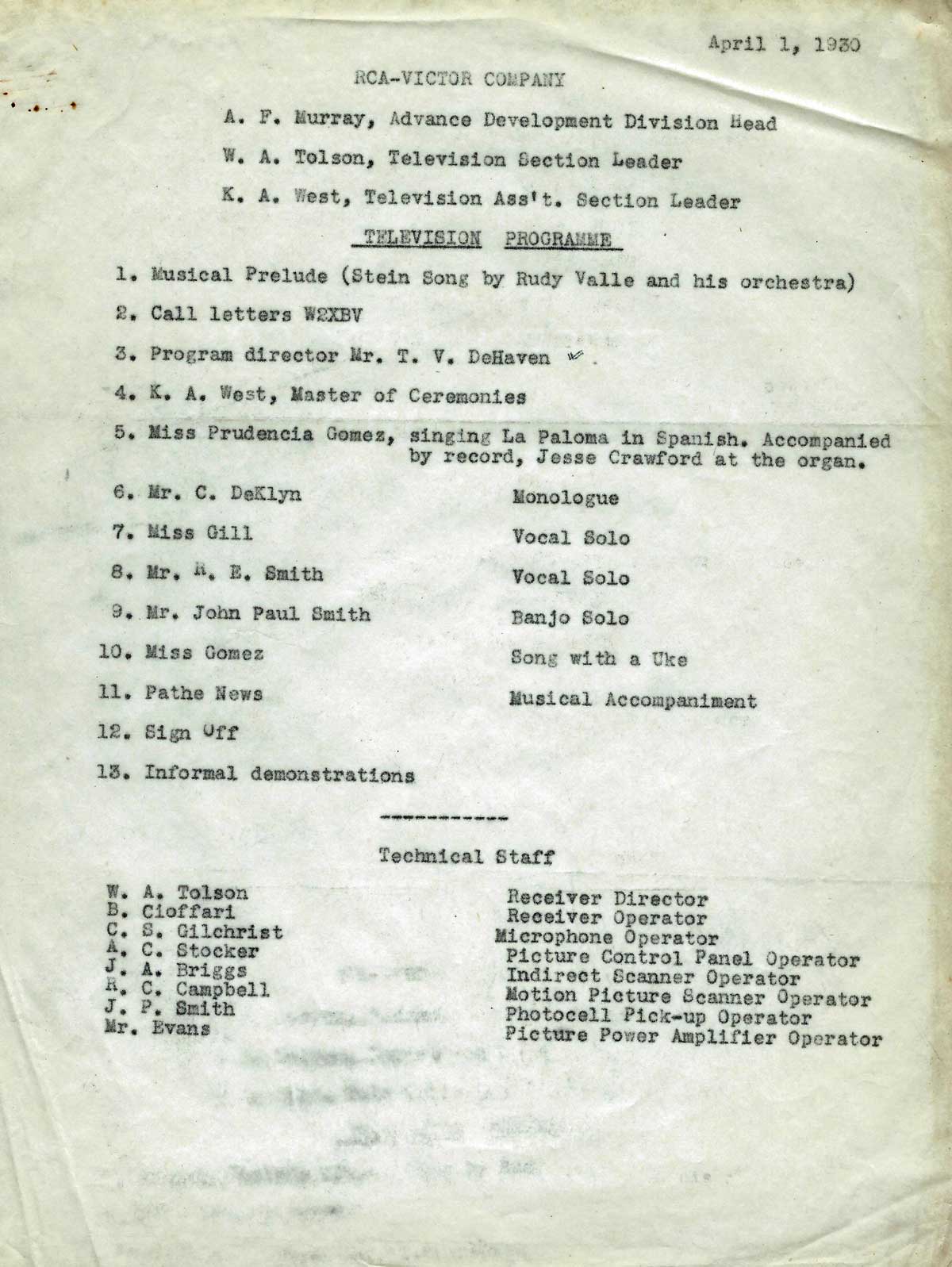
used in these experiments. Here is a 1930 program schedule.

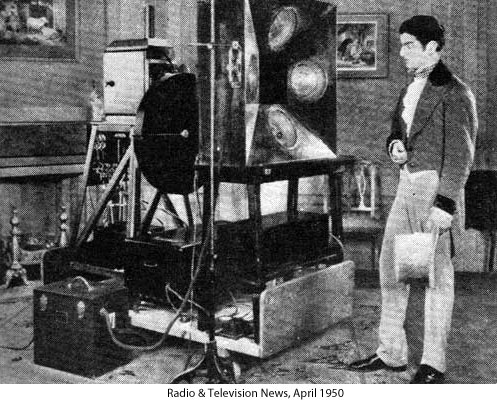
1928 camera
|
1932 Field Trials
The Empire State Building was completed in May of 1931, and RCA leased the 85th floor for a studio and transmitter location for experimental television broadcasts. RCA, through its broadcasting division NBC, applied to the Federal Radio Commission on July 1, 1931 for construction permits for the sight and sound channels of a television station, which were issued on July 24, 1931. The call sign W2XF was issued in December 1931 for the "sight" channel of that station on an assigned frequency of 44Mc (double sideband). The RCA transmitter had an input power to the final stage of about 5Kw, giving an estimated power output to the antenna of about 2Kw. The sound channel of the TV station was separately licensed as W2XK for a 2.5Kw transmitter to operate on 61Mc. Both transmitters were located on the 85th floor and used separate vertical dipole antennas extending from the top of the building. A mechanical camera produced a 120 line 24 frame per second picture, but electronic receivers receivers were used. Starting in the
winter of 1931, and running until mid 1932, an experimental television
system had been used in New York using a studio scanning apparatus. .

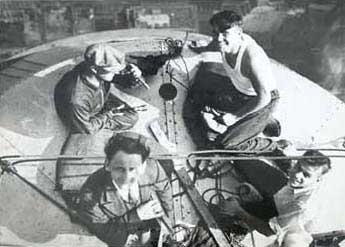
| A 1931 International Newsreel Photo. The caption reads "Putting the
Vision in Television - Here's a vision that would lend color to any
television broadcast. The electricians are installing aerial and ground
wires atop the Empire State Building, world's tallest structure, for use
in television transmission". |
After many years of research and
development an all-electronic television system emerged from the
laboratory in 1933 for actual field tests. These tests were carried out at
Camden, New Jersey. Iconoscope television cameras were used to pick up scenes
both in the studio and out-of-doors. The use of the iconoscope permitted
transmission of greater detail, outdoor pick-up, and wider areas of
coverage in the studio. Experience indicated that it provided a new degree
of flexibility in pick-up performance, thereby removing one of the most
difficult technical obstacles to television.
A scanning pattern of 240 lines
made it possible to obtain a picture with good definition, but as the
frame frequency was 24 cycles, without interlacing , flicker was quite
noticeable.
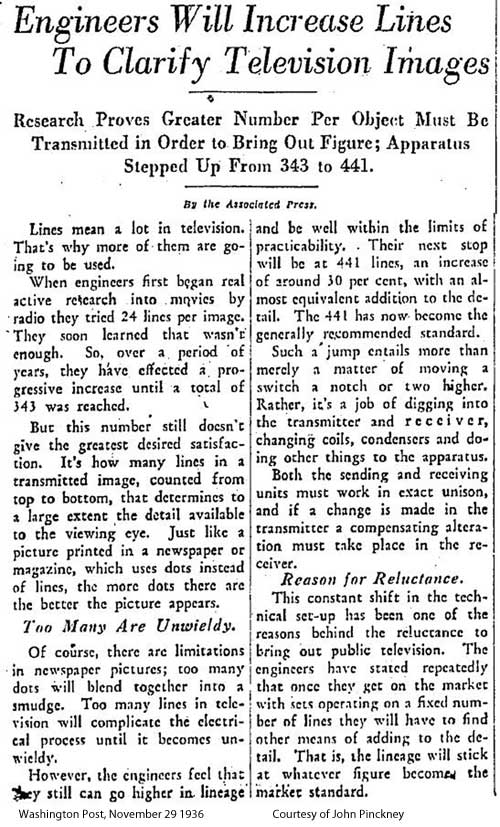
In 1934 the number of lines was
increased to 343, and an interlaced pattern having a field frequency of 60
cycles and a repetition rate of 30 frames per second was adopted. To accommodate the new tests, the W2XF video transmitter was rebuilt as a 10 Kw transmitter, having an output of about 7.5 Kw, designed to transmit on 49.75 Mic, and the W2XK sound transmitter was rebuilt to operate on 52 Mc. W2XF was now able to provide an all-electronic video signal from an Iconoscope source having 343 lines and 30 interlaced frames per second. The Iconoscope cameras were located in the RCA studios at Radio City and linked to the Empire State Building transmitter by both an underground coaxial cable and a radio link.
|
1936 Field Trials
The results of these tests were
so satisfactory that it was decided to continue them in New York City, the
site of earlier RCA tests using a mechanical scanner. The advantage of the
new location was that transmission studies under more nearly the
conditions encountered in actual broadcasts were possible, in particular,
with respect to noise and reflection from buildings. This move was made in
1935, and the second field trials began the next year.
NBC converted a radio studio in the RCA Building (now the GE Building) in New York City' Rockefeller Center for television
use. The transmitter was
installed in one of the upper floors of the Empire State Building, with
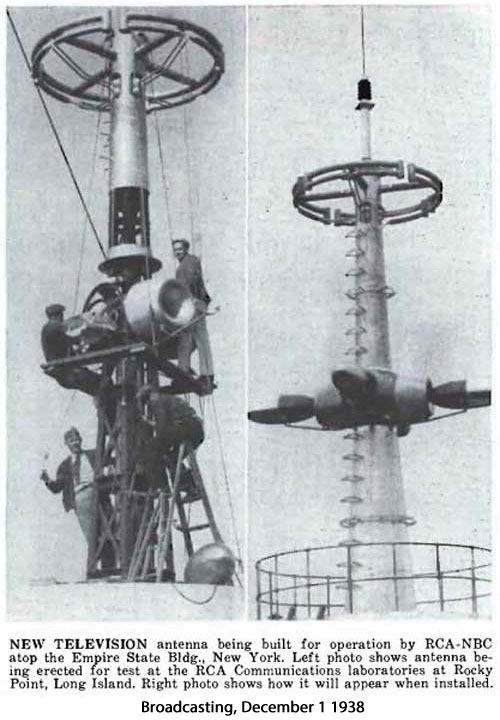
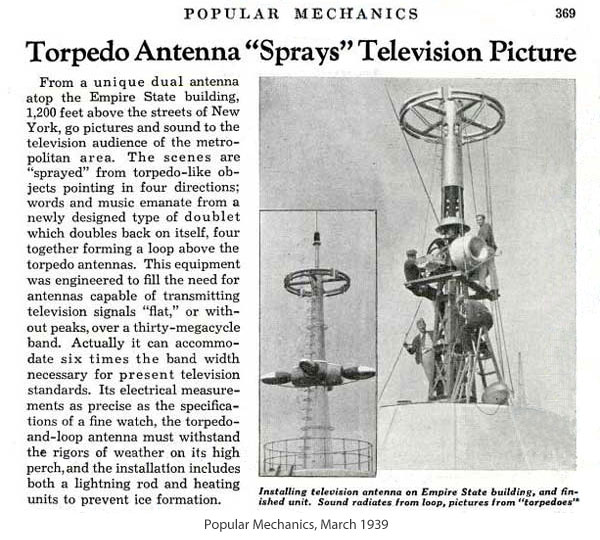
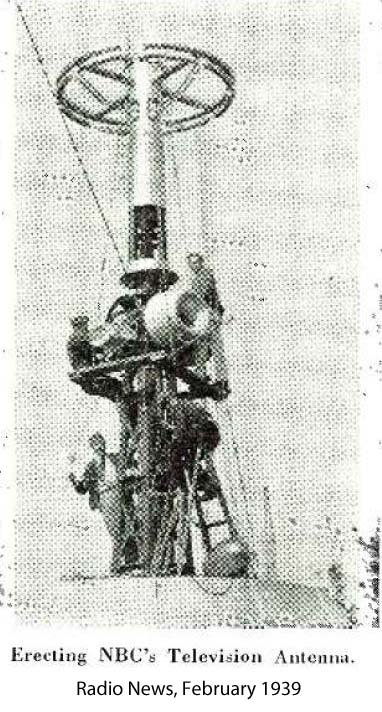
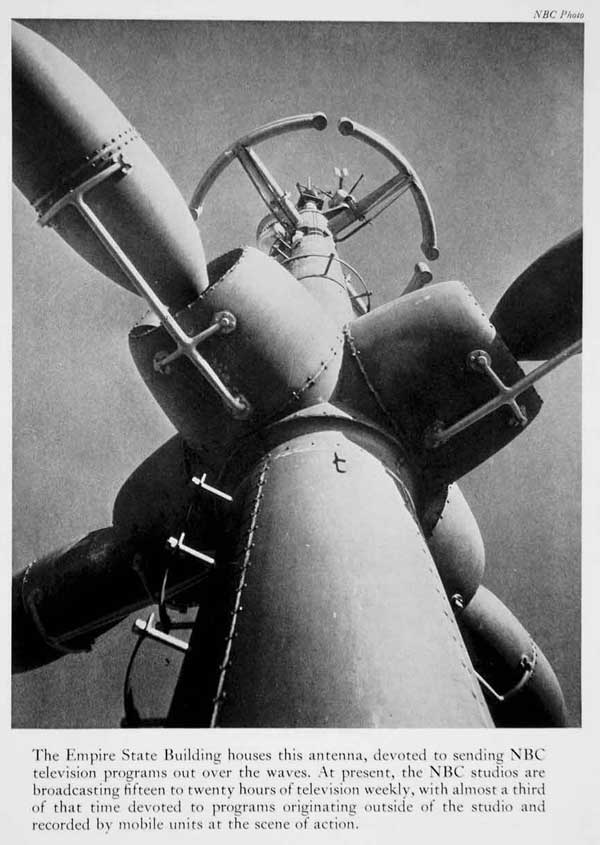
the antenna on the mooring mast, 1285 feet above street level. Two links
interconnected the studio and transmitter. One of these was an underground
coaxial cable approximately a mile in length, the other was a radio link. Video carrier frequency was
46.5 mHz and aural carrier was 49.75 mHz.
On June 29, 1936, NBC began field-test television transmissions
from W2XF/W2XK to an audience of some 75 receivers in the homes of
high-level RCA staff, and a dozen or so sets in a closed circuit viewing
room in 52nd-floor offices of the RCA Building. The viewing room often
hosted visiting organizations or corporate guests, who saw a live
program produced in the studios many floors below. Eventually these
transmissions were received on about 200 experimental receivers scattered throughout the New York area.
During late 1935 and early 1936 RCA manufactured a few nine-inch field test
television receivers, including the RR-359 in our collection. The RR-359
started as a 9-inch mirror-in-the-lid set. The 9-inch round picture tube
faced upwards and was reflected in a mirror under the lid. The lid was
opened at a 45-degree angle to reflect the screen's image toward the
viewer. A rectangular mask placed over the picture tube hid most of the
"roundness" and this produced an image with the now familiar 3 by 4 aspect
ratio of current television in all countries. Initially the set scanned
343 lines (interlaced) and had a continuous tuner capable of tuning 40 to
90 MHz which frequencies include the current low-band VHF channels 2 to 6
and below to the now defunct channel 1. Curiously, the black dial
included the labeling "amateur" between the numbers 56 and 60. This was
the old 5-meter band that moved to 6 meters after World War II. The
lower, extremely heavy chassis contains the power supplies and high
voltage. The upper chassis, which contains the tuner, front-end and
scanning circuits, is a vertical chassis mounted above with its underside
(the guts) facing up against the front.
The first public demonstration of these
field trials took place on July 7, 1936 to RCA's 225 licensees. Major
General J. G. Harbord, chairman of the board of RCA announced that there
were three sets in operation at the time, the most distant in Harrison, N.
J.
In mid 1936 RCA started making the RR-359B, which was a 12 inch set. A
12-inch round picture tube replaced the earlier 9-inch. The overhaul to a
larger screen size may have been due to poor reviews given by the press in
late 1936. The small, 9-inch tube looks more like a 7-inch screen when
viewed in the mirror. That, coupled with its light-green phosphors
creates more of a crystal ball effect than the desired "movies and live
action in your living room" effect that the press had anticipated.
The RR-359B had a larger cabinet but used the same two chassis as the
RR-359. The first 12 inch sets were built with continuous tuners
and 7 controls under the lid. Later versions had only 3 controls under the
lid, and had a single 807 horizontal output tube in place of two 42s.
These sets had detent tuners with 12 positions, and a very bizarre
frequency allocation that does not simply progress higher in frequency as
the tuner number goes up, but seems to jump around randomly. This may have
had something to do with how they assigned the broadcast and relay
channels used by RCA's remote coverage
trucks. These frequencies are now assigned to our current FM
radio band (88-108 MHz) but at the time were additional (secondary)
television channel assignments. The
original 12 inch sets used tubes with a yellowish green phosphor.
Apparently the high temperature required in the annealing discolored the
phosphor. By 1937 RCA had perfected the white phosphor.
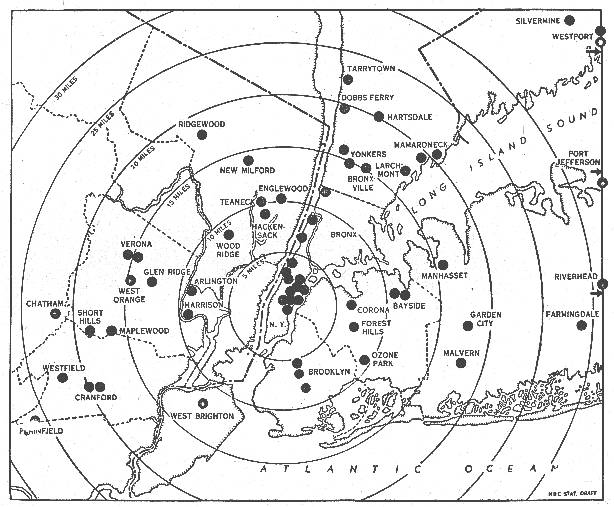
About 100 of
these sets were made, and they were located at various points within a
radius of 50 miles of the W2XF transmitter. These, together with field strength
measurements, gave detailed information as to the effect of the terrain on
the received pictures. They also facilitated obtaining data on the
reaction of a great variety of people to different types of programs.

Location of Field Trial Sets
None of these receivers were sold to the public, but were installed in
the homes of executives and engineers. The public could see the
RCA sets in the lobby of Rockefeller Center in New York. The RCA
field test receivers, model RR-359, represented the first production of
a home viewer in the United States, albeit a prototype model that was
not for sale. Each set had cost about $1,500 to manufacture in 1930s
dollars.
NBC demonstrated TV to
200 invited guests on November 6, 1936. The sets used in the demonstration
were all RR-359B 12 inch models. RCA encouraged
amateurs to experiment with television, and sold parts for home made receivers.
In 1937, RCA and other
experimental broadcasters moved up to 441 lines, AM sound. This was the RMA (Radio Manufacturer’s Association) standard at the time. It is probable that RCA transferred its old call sign W2XBS for these broadcasts. Programming was extended to include pickups remote
from the studio. NBC’s mobile television vans, then a great curiosity,
appeared on the streets of New York for the first time on December 12,
1937.
.
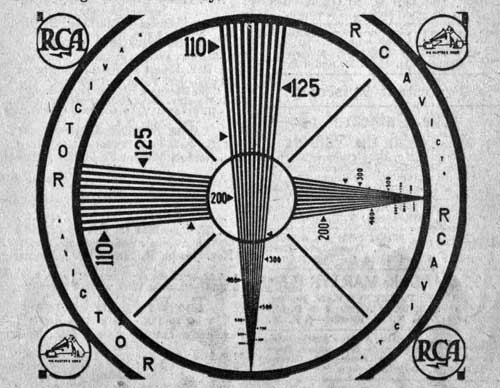
1937 RCA Test Chart
|
|
1939 - The World's Fair
In 1939, RCA introduced television to the American public at the World's
Fair. At the same time, the station began regularly scheduled
broadcasting, with both studio and remote programming. Here are program schedules from
1939-41.
As W2XBS, the station scored numerous
"firsts", including the first televised Broadway drama (June 1938), live news event covered by mobile unit (a
fire in an abandoned building in November 1938), live
telecast of a Presidential speech (Franklin D. Roosevelt
opening the 1939 New York World's Fair), the first live
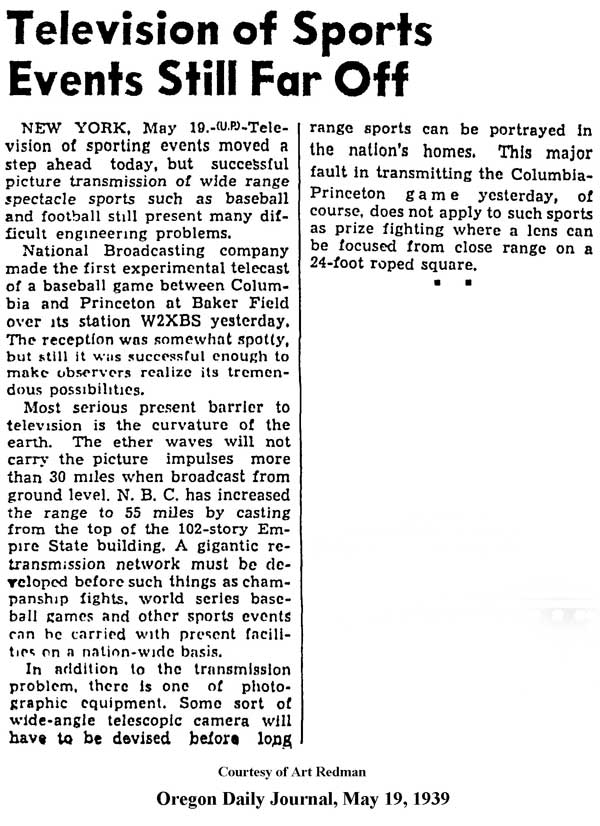
telecasts of college and Major League Baseball (both in
1939), the first telecast of a National Football League
game (also in 1939), the first telecast of a National
Hockey League game (early 1940) and the first network
telecast of a political convention (the 1940 Republican
National Convention).


|
1941 - First Commerical Station
The station began commercial television operations on July 1, 1941, the
first fully-licensed commercial television station in the United States.
The call letters were changed to WNBT and it originally broadcast on
channel 1. There had been experimental, non-paid advertising on television as far back as 1930. NBC's earliest non-paid commercials may have been those seen in the first major league baseball game ever telecast, a game between Brooklyn and Cincinnati, on 8/26/39. In order to secure the rights to show the game, NBC allowed each of the Dodgers' regular radio sponsors at the time to have one commercial during the telecast, and these were done by Dodger announcer Red Barber. For Ivory Soap, he held up a bar of the product, for Mobilgas he put on a filling-station-attendant's cap while giving his spiel, and for Wheaties he poured a bowl of the product, added milk and bananas, and took a big spoonful.
On the first day of broadcasting as a commercial station, WNBT aired the first
television commercial. Here is the NBC schedule for the first night:
1. Lowell Thomas News (Sun Oil)
2. Uncle Jim's Question Bee (Lever Bros -- Spry)
3. Truth or Consequences (Lever Bros -- Ivory Soap)
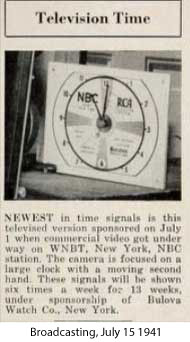
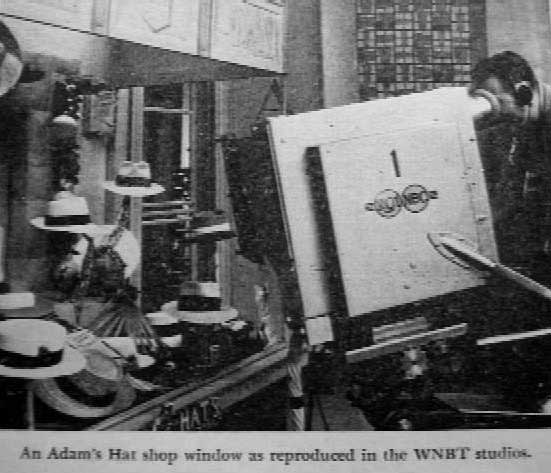
The evening began with a spot announcement for Bulova watches -- a tight shot of a watch face with no voiceover. Other spot ads that evening were for Botany ties (a series of art cards featuring the cartoon lambs then featured in Botany's print ads) and Adam hats (a slow camera pan of a simulated window display of the sponsor's product.)

Courtesy of Steve Dichter
Audio recordings of the evening's programming exist at the Library of Congress, but no visual recordings exist. |

Courtesy of Steve Dichter
|
World War Two
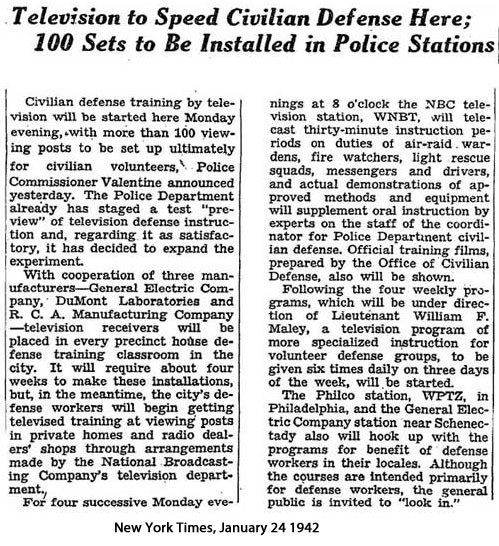
During World War II, RCA diverted key technical TV staff to the U.S.
Navy, who were interested in developing a TV-guided bomb. WNBT's studio
and program staff were placed at the disposal of the New York Police
Department and used for Civil Defense training. Public programming
resumed on a small scale during 1944. Here is a brief audio clip announcing a TV show from 1944 (courtesy of John Pinckney)

Courtesy of John Pinckney
|
After the War
In 1946, the station changed its frequency from channel 1 to channel 4
after channel 1 was removed from use for television broadcasting.
(Channel 4 was previously occupied by WABD before moving to channel 5)
The station changed its call letters on October, 1954 to WRCA-TV (for
NBC's then-parent company, RCA) and on May 22, 1960, channel 4 became
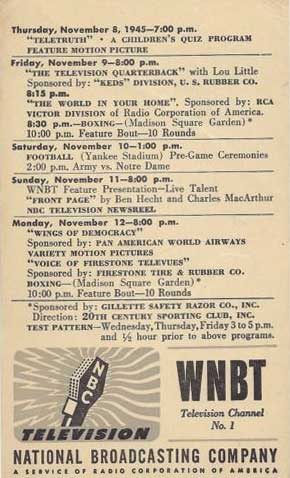
WNBC-TV. Here is a program schedule from 1945.
|
Other RCA Tests
RCA
experimented with other uses of television. In 1939, RCA demonstrated
television reception in and transmission from an airplane.
RCA also experimented with two way television.
|
(Thanks to Nat Pendleton, Darryl Hock and Jeff Lendaro for information used in this
article)
Invisible text to format smartphones. xxxxxxxxxxx xxxxxxxxxxxxxxxxxxxxxxxxxxxxxxx xxxxxxxxxxxxxxxxxxxxxxxxxxxxxxxxxxxxxxx xxxxx xxxxxx xxxxxxxxxxxxxxxxx xxxxxxxxxxxxxxxx xxxxxxxxxxxxxxxxxxxxxxxxxxxxx
|