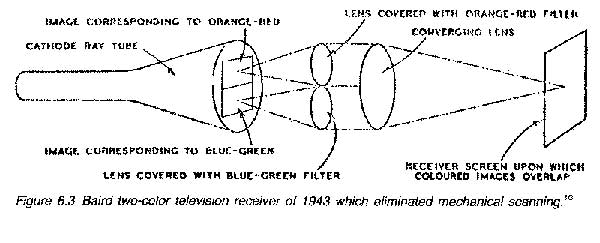
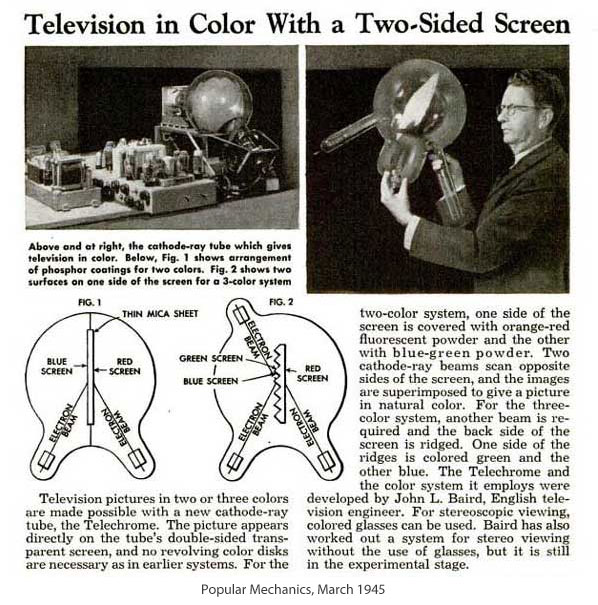
This system was based on designs evolved by John L. Baird.
In 1943, he designed a two color system, with two images produced on the
face of a CRT. Lenses then converged the images.
James T. Hawes commented:
What you show is more like Baird's line-sequential system that succeeded Telechrome. The idea was to reduce flicker in large areas of color. I've seen drawings of that that include three-color, side-by-side images. Apparently Baird never progressed beyond the drawing stage, or the prototypes didn't work satisfactorily. No evidence that he ever built the line-sequential tube exists.
Maury Markowitz commented:
James T. Hawes comments that the Baird system for 3D was not the Telechrome, and used the earlier mechanical scanning system. While it is certainly possible to use a mechanical system for 3D, the same is true for the patterned screen system as well. Contrary to his statement, I believe the 3D system mentioned *in that article* was indeed referring to the Telechrome tube.
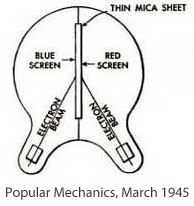
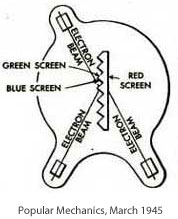
Consider the Figure 2 schematic in the Popular Mechanics illustration. This image shows the three gun screen viewed from one side - someone actually watching the program would be sitting to the right or left (I assume the right, looking at the smooth side of the screen). In this case they view the red image directly, and the blue and green images being projected from above and below are being mixed by the plate.
But consider what happens if you turn the entire tube 90 degrees clockwise around the line running from the viewer to the screen. Now the ridges that separate the blue and green signals are running vertically, and those two electron guns are on the left and right side of the viewer. Turning off the “red” signal and sending the left and right images into the the blue and green guns produces a 3D image identical to those seen on the front of some magazines using the same ridged structures.
This could be accomplished with relative ease compared to the three-tube version of the Telechrome. It would still suffer from the alignment and scanning problems that ultimately ended development along these lines (and the similar Geer tube), but it would be perfectly possible to use the tube for 3D display.
James Hawes replied:
On Wikipedia, Maury repeats his "new" news about Telechrome. (Of course I must greet "new" Baird material with skepticism.) At Wikipedia, I've examined the purported source material. I find zero specific references to a demonstration. The Telechrome patent doesn't mention Telechrome autostereography (by any method). In the literature, apparently there is no mention of Telechrome autostereography by lenticular means. According to Herbert (who was there), Telechrome 3D was only available with anaglyph glasses. (Technical comments at the time called the stereo effect "a stunt.") Perhaps I missed something. Might Mr. Markowitz have uploaded the wrong source material?
I don't want to sound contentious. But "lenticular Telechrome" doesn't hue to the history in my references. (Even in Baird-facing texts).
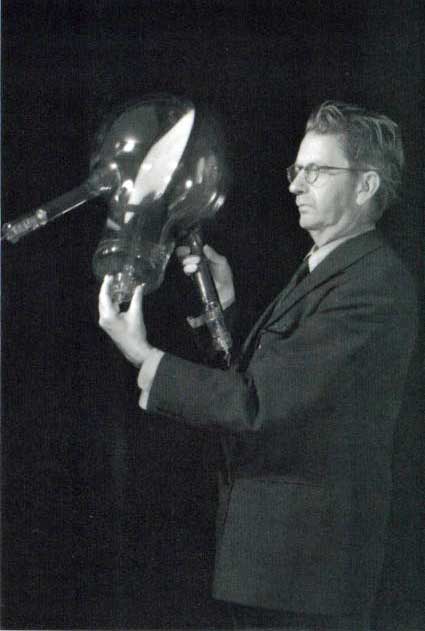
Beginning in 1942, Baird designed color a CRT producing two-color images, using red-orange and blue-green phosphors. The two color tube had three necks. Baird built several of these tubes.
1942 Photo
Courtesy of the Science Museum/Science & Society Picture Library
James T. Hawes commented on the above article:
The last sentence says "Baird has also worked out a system for stereo viewing without the use of glasses, but it is still in the experimental stage." This sentence seems to apply to Telechrome. Actually the Baird 3D system without viewing glasses *doesn't* use a Telechrome tube. Instead, the 3D system without glasses requires a spinning color wheel and a spinning shutter. The shutter separates images and alternately aims them at the left or right eye. (Herbert, Ray. Seeing by Wireless, p. 24.)
This 3D system also requires the viewer to sit in a rigid position. Otherwise, the 3D effect collapses. (Abramson, Albert. The History of Television, 1880 to 1941, p. 271.) These restrictions doomed Baird's system. As with many Baird innovations, this one was a press curiosity but an engineering kludge. It never developed into a useful product. In fact, it never even became marketable.
Rick Plummer commented:
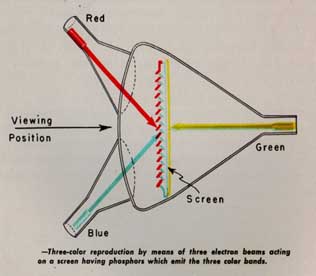
Baird also proposed a 3 color tube, using a 4 necked tube. Inside the Telechrome tube is a transparent screen having parallel
ridges on the side toward the viewer and flat on the opposite
side. There are three electron guns whose beams are modulated
by the three color band signals. The beam from one of these
guns can impinge on only one side of the ridges. This side is
coated with a phosphor emitting the color band which is to be
reproduced by the corresponding gun. The second gun can send
its beam only to the opposite side of the ridges, this side being
coated with phosphor emitting the second color band. The beam
from the third gun strikes the flat surface of the screen, which
carries a phosphor emitting the third color band. The third
color, produced on the back of the screen, shows through the
transparent supporting material and mixes with the other two color
band produced on the sides of the ridges. The ridges are very
narrow and closely spaced. Two of the guns are in such positions that
their beams travel different distances to opposite sides of the
screen.
The artist's conception (above,
right) is inaccurate. The shape of the tube isn't at all the shape of Telechrome. No photos of Telechrome show a tube with a gently sloping CRT face. To avoid implosion by atmospheric air pressure, Baird adopted a bulbous profile for the tube. The interior screen was far inside the tube. The artist's conception incorrectly shows a screen just behind the viewing window. Most important, in this drawing, two necks plainly block the viewing area. This tube concept is completely implausible and impractical.
The three-color tube in your description would have been *very* difficult to build and assemble. Each serration would be only one or two lines deep. Add to that this fact: Arthur Johnson (Baird's glassblower) had to fold the tube elements and insert them into a ready-made tube! Then he erected the folded elements inside the tube, probably using levers or strings. He said that the process was much like inserting a ship into a bottle! (See Ray Herbert's charming book, p. 26.)
Folding a serrated mica target and holding it in microscopic register with a flat mica target must have been daunting!
I don't know if Baird ever actually achieved the 1,000-line Telechrome picture. This was a dream for his presentation before a review committee. He also mentioned that Telechrome would adapt to the British 405-line system. I can imagine a 202.5-line field of red-orange and then a field of blue-green. The committee probably didn't adopt Baird's proposal for many reasons. One of these would be the 50 percent reduction in resolution! The flicker rate would also double.
Herbert's book talks about Baird's demonstration version: 600 lines with triple interlace. That would be triple interlace (200 lines per each scan) for red-orange. Then the same for blue-green. That makes six scans per frame!
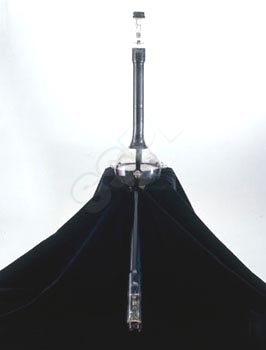
The rear neck could face the screen. The tube on display in England has one slanted neck, allowing front viewing, plus a straight rear neck. Then there's the third neck, which is the original neck of the Hewittic rectifier. This neck seems to support the two-sided mica plate. Some Telechrome tubes had two slanted necks plus the Hewittic neck. Such tubes might allow viewing from either side, with the rear viewer watching a mirror image.
Notice that the necks are longer than they appear in the patent drawing. Also, the target appears to be smaller than in the drawing. As the draftsman was at work, a bit of idealization took hold.
As far as I know, Baird never built or demonstrated the three-color version (with four necks). At least, no museums have such a tube on display.
The color drawing that you show must precede the idea of reusing a Hewittic envelope. One advantage of the Hewittic envelope is that it allows a fairly large picture without very thick glass. Unfortunately the Hewittic tube makes the front of the CRT protrude forward in a very bulbous way. Also, the picture buries itself way down in the tube's center. The necks jut out in three directions, increasing cabinet size and weight.
Telechrome was the intended replacement for projection displays with color wheels. Line-sequential, if it had worked, would have succeeded Telechrome. I've read rumors of a one-neck or even a one-gun Telechrome-like tube. This is another mystery that never turned up anywhere. Probably Baird never built such a tube. The Sydenham Web site insists that this tube was a precursor to "Trinitron." How wrong. If Baird ever could or did build such a tube, it wouldn't be a Trinitron, not even close. Trinitron has far too many distinguishing differences, starting with three cathodes instead of one.
The three-color Telechrome is a nice idea on paper, but no examples exist today. Nobody knows if Baird ever built one. Nobody knows if building one was even possible or practical. After he built his Telechrome tubes, Baird promoted the two-color version, saying that two-color was more practical. He said that he liked it because two-color would adapt to the existing 405-line TV service. Only "a few changes" would be necessary. All these changes would take place in the studio and not the home. (Of course for color reception, the homeowner would have to buy a pricey, two-color Telechrome TV.) Two-color Telechrome could adapt to either color TV or 3D. Apparently having both color TV and 3D would require extensive changes. Otherwise, no color reception would be possible. For 3D reception, the receiver would have to be two-color. The viewer would have to wear anaglyphic (orange-cyan) glasses.
Probably Baird oversimplified the cost and complexity of adapting the British broadcasting system. First, after World War II, England faced years of reconstruction work. Second, most citizens couldn't afford a black-and-white TV, let alone a color one. Third, retrofitting TV studios for color and developing new production procedures would have been labor intense. Fourth, the Telechrome wasn't ready for production. Besides, no color TV manufacturing facility existed. Telechrome's splayed necks and bulbous tube front would have forced massive, difficult-to-ship sets. Fifth, what about product safety? Telechrome's impressive publicity ignores the necessary x-ray, drop, incineration, and tube-implosion ratings.
RESOLUTION
Above I mention the 50-percent reduction in resolution and double flicker rate when adapting Telechrome to 405-line British TV. These problems might not both occur at once. A more precise analysis presents two choices...
--A. Resolution drops to 202.5 lines. (One 202.5-line, red-orange field interlaces with one 202.5-line, blue-green field.) Repetition rate: 25 fps. In large areas of mixed color, flicker increases.
--B. Repetition rate falls to 12.5 fps. Resolution remains 405 lines. (One 405-line, red-orange frame and then one 405-line, blue-green field.) There is an overall flicker increase. Lip-sync deteriorates. (Notice the lip-sync problem on some YouTubes and Skype videophone messages.)
THE TEAPOT TUBE
Your museum owns an ancestor of the Telechrome tube (the Baird/Rauland projection CRT)! Baird derived the Telechrome display tube from the teapot tube. (Note that the Baird invention *isn't* original. It's an improvement on the teapot. The patent title clearly mentions that this is an *improvement.*) Baird used a Hewittic mercury vapor rectifier envelope, and inserted electrodes similar to those in the teapot tube. There are two teapot necks, but one teapot target. One neck aims at the front of the target. The other neck aims at the back. In other words, a Telechrome is a teapot tube with two necks and a two-sided target. Instead of an image projector, you wind up with a direct-view tube. The patent allows for either field-sequential or simultaneous scanning. I don't know if simultaneous scanning would work. But sequential scanning apparently did. Since Baird proposed converting the EMI system to color, field-sequential Telechrome displays would have been the way: 202.5 lines of cyan on the front target, and then 202.5 lines of red on the back. Never mind problems with decreased resolution and increased flicker.
Later, Rauland licensed the teapot from American Baird Co. and continued development.
Here is some additional information, courtesy of Stu Andrews:
The system was called " Telechrome" and used modified
theatre arc lamps as the basis for the three-gun CRT.
Baird demonstrated the invention to several experts and newspapers
at the time. The BBC publication "Radio Times" in 1942
described the picture as " entirely natural" .
Several line rates were tried, with the final versions of
Telechrome running at 1000 lines.
Baird died in 1946 and Telechrome was forgotten in the rush to
re-start broadcast TV.
Here is a projection set using the Baird two-color system:
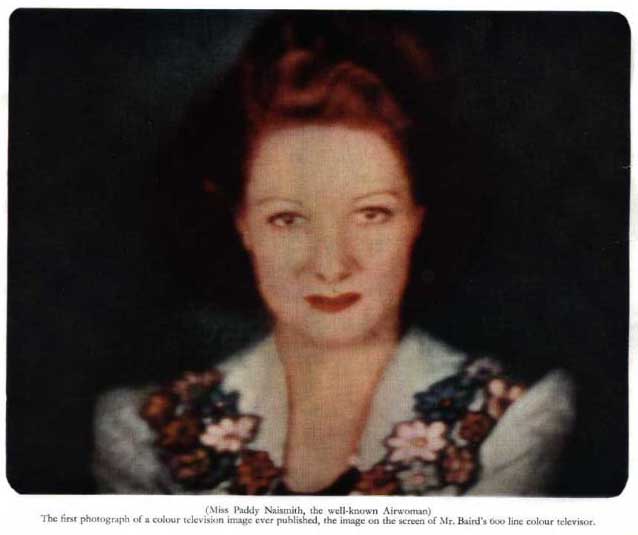
From the British "Journal of The Television Society", September 1941