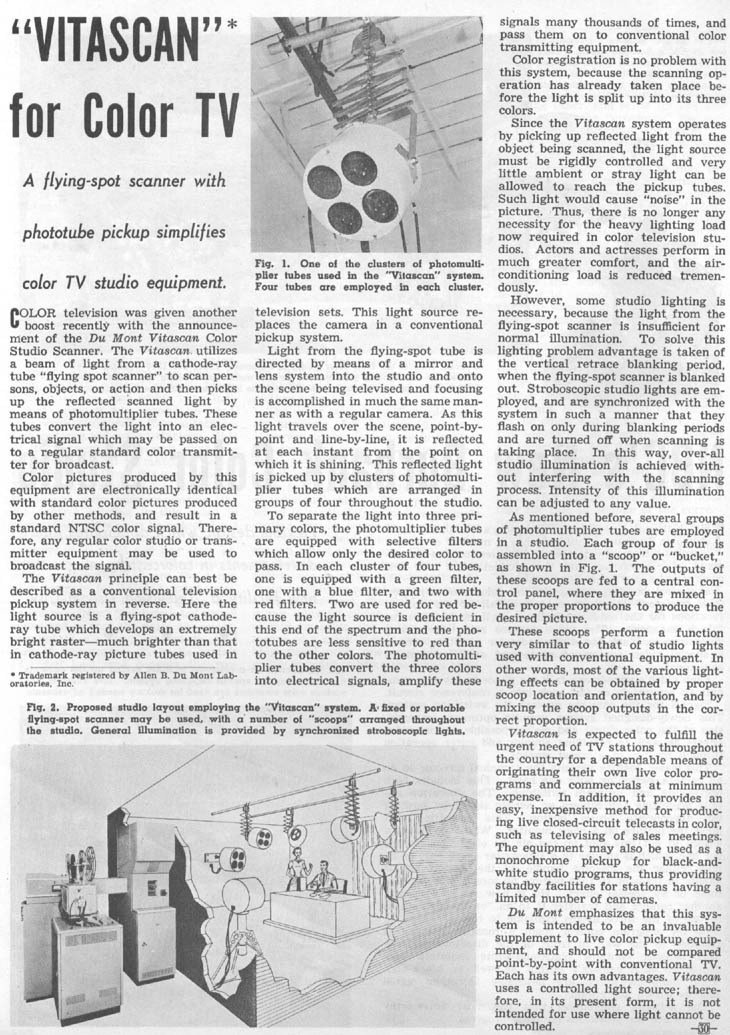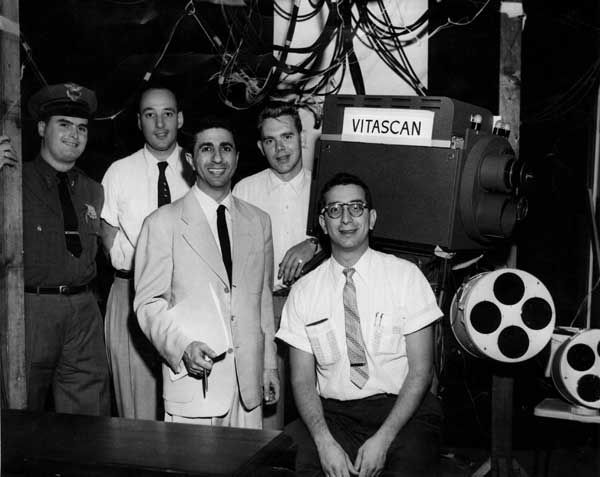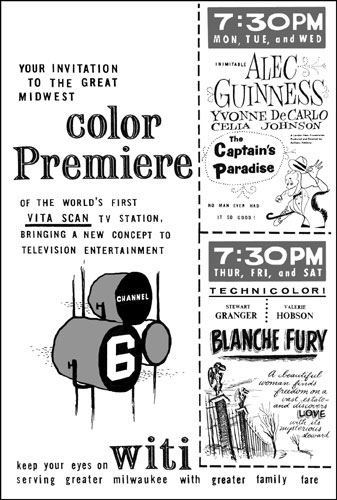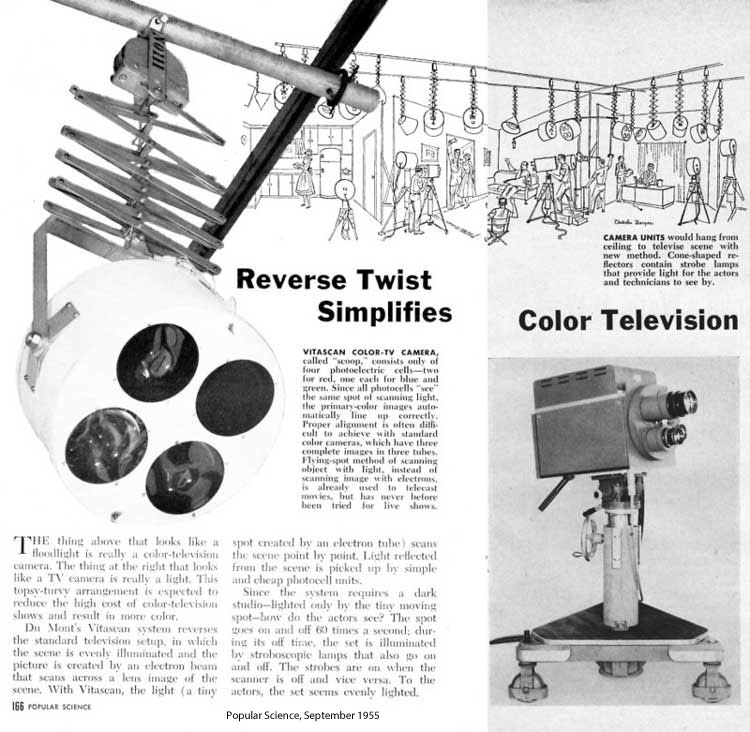

Early Color Television DuMont VitascanDuMont's Vitascan system was used to televise small set, single camera shows such as news. The entire set was enclosed in a box and the camera projected the light from a high-resolution white phosphor raster through the camera lens onto the subject. Large reflector scoops, similar to those used for floodlights, housed multiple phototubes, which were equipped with R, G, and B Dichroic filters. The photo tubes picked up a continuous stream of R, G, and B video signals in perfect sync with the scanning system, which could be displayed line by line rather than field sequentially. To aid in walking around inside the enclosed set strobe lights were pulsed during vertical blanking interval, which produced a ghostly sort of moonlight effect. The Vita Scan system was very simple using only a single camera tube, which eliminated multiple tube camera registration problems. It would have worked great outdoors if we could have figured out a way to pulse the sun to shine only during vertical blanking. At a trade show RCA posted a sign on their new camera "Works In The Sunlight" and Bob Bollen's sign on the Vitascan camera countered with "Works In The Dark." Vitascan was designed to work with the NTSC color system. Steve Dichter sent us this 1956 Vitascan Ad ad from station WITI in Wisconsin. The ad announces their color tv premiere using the DuMont Vitascan system. The two features listed at the right "Captain's Paradise" was a b&w picture, while "Blanche Fury", which aired at the end of the week, was in Technicolor. The image is from the Milwaukee Television History site, courtesy of Dick Golembiewski. Here is a technical paper presented in 1956 on Vitascan, a brochure, and an article from the September, 1955 issue of Popular Science, courtesy of Wallace Dickson.
Courtesy of Richard Diehl |