
|
Dear Mr. Sanders:
This is in response to your E-mail of February 2 about research
for your article on the earliest days of American commercial
television broadcasting.
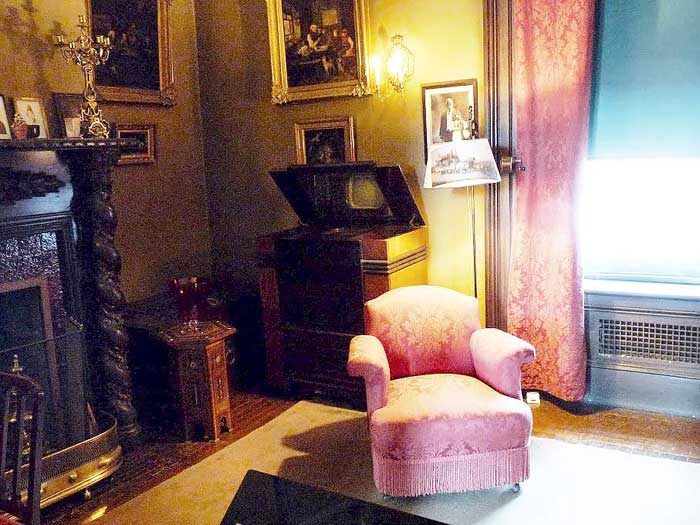
There is an early television set on display in the Roosevelt home
in Hyde Park. For information about the provenance of the set,
contact Anne Jordan, Curator, National Park Service,
Roosevelt-Vanderbilt National Historic Site, 4097 Albany Post Road,
Hyde Park, New York 12538. There is a letter in the
President's Official File on Radio and Television (OF136), dated
August 30, 1939, thanking Mr. Carlton D. Smith of NBC for "the
new television receiving set and for putting the old radio sets in
condition" at Hyde Park. There is also a General Electric
radio-television combination with an 8-inch picture tube in a
mahogany cabinet in the Library's museum collection. Its
provenance is unknown.
We have found no record of which television programs, if any, the
President may have viewed. In fact, he refused the offer of a
free television set for his hilltop retreat, preferring to be free of
both television and radio while relaxing there. We have also
not located any photographs of the President in his Hyde Park home
with the television set.
In a letter to Frank P. Graham, president University of North
Carolina, Chapel Hill, January 18, 1939, the President said it was
impossible for individuals in government to cover their subjects and
the nation by personal appearance. Some times he
"wished the advent of television could be hastened".
In a campaign radio address from the White House, November 2,
1944, the President spoke of the end of the war and a era of
expansion and production: "We can all look forward to
millions of new homes, fit for decent living; to new, low-priced
automobiles; new highways; new airplanes and airports; to television;
and other miraculous new inventions and discoveries, made during this
war, which will be adapted to the peacetime uses of a peace-loving people".
In a wire to the first annual conference of the Television
Broadcasters Association, December 10, 1944, the President stated
that "television is an important matter in our national life and
its progress will be of great interest to everyone."
We hope that this information is of interest to you.
Yours sincerely,
RAYMOND TEICHMAN
Supervisory Archivist
|