
Early Television  
Mechanical TV History How it Works Mechanical Sets at the Museum Gallery Database Summary Broadcasting Technical Information Restoration Advertising Articles Roger DuPouy's Site Peter Yanczer's Site Gerolf Poetschke's Site Eckhard Etzold's Site
Early Electronic Television History American Sets at the Museum British Sets at the Museum Gallery Database Summary Broadcasting CRTs Accessories Technical Information Restoration Advertising Articles Gerolf Poetschke's Site Eckhard Etzold's Site
Postwar American TV History American Sets at the Museum British/Europen TV History British/Europen Sets at the Museum TV in the Rest of the World Gallery of Unusual Sets Broadcasting CRTs Accessories Technical Information Restoration Advertising Articles Eckhard Etzold's Site
Early Color TV History Sets at the Museum Gallery Database Summary Broadcasting CRTs Accessories Technical Information Restoration Advertising Articles Pete Deksnis's Site Ed Reitan's Color Television History Eckhard Etzold's Site
The Early Television Foundation About the Museum Directions to the Museum Articles about the Museum Support the Museum Join our Email List Our Newsletter - "What's New in Old TVs" Equipment Donations Museum Members and Supporters Monthly Online Meetings Annual Convention Swapmeets
What's New on the Site Classifieds Parts for Sale Resources North American Radio and TV Museums Search the Site
Contact Us Facebook YouTube Channel

Mechanical Television

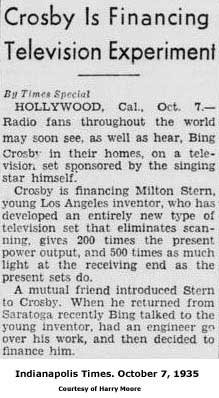
Milton Stern System

Early Television

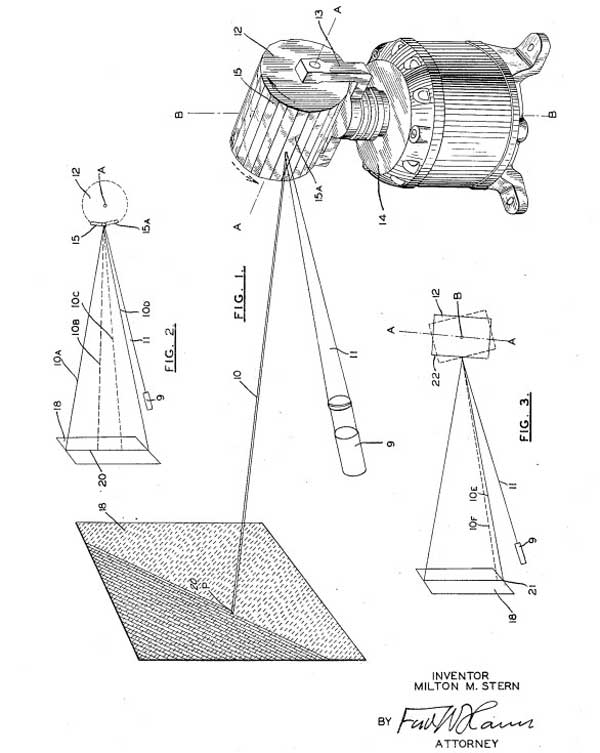
Milton Stern Patent

Early Television

Courtesy of Harry Moore

Comment from Paul Lindemeyer: From the patent letter, seems like it was a mirror drum/ball that sent just a pixel at a time to a screen, instead of a line at a time. ie very much hybrid technology, out of date before it could go anywhere.

The 1935 movie "Murder by Television" features the Stern Scanner that was used by WRNY. Here are comments by Art Redman of the )Northwest Vintage Radio Society (NWVRS

Murder By Television:  Film The Stern Scanner in Operation  
By Art Redman

The  movie Murder by Television stars Bela Lugosi in a dual role-playing twin brothers Arthur and an unnamed twin. Also,  June Collyer, and Huntley Gordon as Dr. Scofield, M.S.B.S.  The 53-minute movie opens with several  magazine clippings of television like “Television Comes to the Home” and Successful Television Programs Televised by WRNY”. [Hugo Gernsback]. The one featuring  Lee de Forest in “Miracles in Television” is the most noteworthy. The mechanical television transmitter broadcasts on  0.75 meters [225mHz].  The scanning system was invented in 1934 by Milton M. Stern: U.S. Patent 2,099,872 granted in 1937  consisting  of rotating curved reflectors. The subjects of the broadcast are  illuminated by eight or more high intensity electric lights used in mechanical broadcast systems which are picked up by a photocell.  By watching the film, modern viewers can see the Stern’s device in action.   

Is this movie  Science Fiction,  futuristic  mystery or both? The electronic receivers and world- wide television network and  death ray did not exist in 1935.  Some DVD outlets call the movie the “Houghland Murder Case”.  James Houghland, invents a new method by which television signals can be instantaneously sent anywhere in the world,  and refuses to sell the process to the C.M.P. Television Company  who send agents to acquire the patent rights any way they can even if it includes murder.   

On the night of his initial worldwide  broadcast from his studio at  White Plains, New York, Houghland is mysteriously murdered  in the middle of his live television demonstration nineteen minutes into the film.  It is then up  to Police Chief Nelson to determine who the murderer  from the many suspects  present. It turns out, Arthur Perry’s brother is a police inspector who solves two  crimes:  How Houghland was murdered and the stabbing death of his twin brother. Doctor Scofield leaves during the television demonstration to place a telephone call. A blinding  flash of light is seen by the television viewers which is  a  death ray  activated by the noise from a telephone  bell from within  the studio.   


Early Television Museum
5396 Franklin St., Hilliard, OH 43026
(614) 771-0510
info@earlytelevision.org