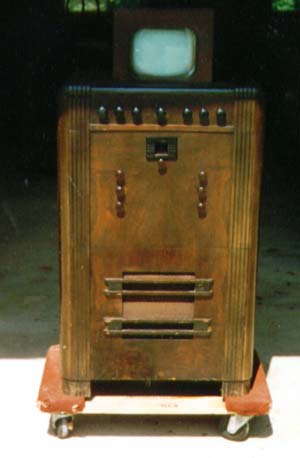

Early Electronic Television History of our RR-359The set in our collection was probably owned by RCA until about 1940. It was then acquired by Dick Burtner, an RCA engineer. He was likely a "2nd string" engineer; maybe responsible for set-ups, installations, service etc., and not the development of products. When the original CRT went bad, Burtner converted the set into a direct view design, removing the mirror, and placing an experimental, unmarked tube possibly made by Philco, on the top. He routed out a front section of the lid in order to allow for the curve of the round picture tube and thereby sink it down. He then cut the wooden mask out of the original "deck" (wood surface under the lid surrounding the screen) and built a wood housing around the rest of the tube. Finally, he rotated a bank of seven knobs 90 degrees toward the front and drilled seven corresponding holes in the top-front of the cabinet. According to Edgar Rohr Sr., a friend of Burton, this conversion was done late in 1943. Rohr said that he had seen the set running with a direct-view picture tube in early 1944 while visiting Burtner in his New York City apartment before Rohr shipped out to England to be with the D-Day forces. Mr. Rohr, who had been the mayor of Manassas, Virginia for several years before, collected automobiles, phonographs, radios, music boxes, toys and any kind of interesting antique or gadget. His wife collected dolls and clothing. Together they had created a private museum above the garage connected to their five and dime store. Edgar Rohr Sr. apparently acquired the set in around 1965 Nat Pendleton discovered the set in 1988 and spent a year or so occasionally visiting Mr. Rohr and trying to buy it. When Rohr died, his elderly wife requested that her son sell none of her husband's collectibles and so the estate remained frozen for several years until she died. In February 1997 Pendleton got a call from the son and we negotiated over the next few months. By May Pendleton had purchased the set. In 2003 the Early Television Museum was able to acquire the set. RestorationThough the cabinet had been radically altered, most of the electronics were left intact and could be restored. Craig Roberts of Laurel, Maryland was able to bring this 63 year-old television back to original operating condition. He filled the original shells of capacitors, cans and resistors with modern components to preserve the original cosmetic appearance, even though most of these components are hidden under the chassis. Such "purist" restoration is often done on early electronic TV sets because of their rarity. Fortunately, Craig had Dick Burtner's original blueprints. The schematic was drawn on two sets of blue copy paper; so the blueprints were blue. These prints were of the RR-359, enabling him to recreate the original circuitry as close to 1936 as possible. The continuous tuner in this set is totally original (1936) and the tube types left and right of it are also of the oldest generation. Many other 359s, including the other surviving 9-inch and several of the 12-inch sets had changed the tubes (tube types) used in this area (up top, near the upper controls) to more modern ones. The tuner displays the original 4 mHz increments assigned to channels in the 343-line era before the upgrade to 6 mHz channels and 441-lines occurred in February 1937. The cabinet restoration involved restoring the lid, building a new "deck" and plugging the seven holes that Burtner drilled in the top-front in late 1943. The lid's gouge where the CRT once rested was filled in and the top surface was reveneered. A near identical lid strut--that kept the lid raised for viewing, was obtained from an RCA-Victor radio-phonograph from the late 1930s. The deck was designed by information and measurements taken by Jeff Lendaro. The original piece of wood that frames the CRT helped us obtain the exact size and aspect ratio when the deck was built. Other Surviving Field Trial SetsOf the approximately 100 RR-359s that were made, it is not known how many were 9 inch and how many were 12 inch. The serial number of our set's cabinet is 1018, and that of the other surviving 9 inch set is 1048. Two of the surviving 12 inch sets have numbers 1049 and 1071. From this you might conclude that 48 9 inch sets were made. Since the two designs use the same chassis, it is likely that many of the 9 inch sets were gutted and the chassis put in 12 inch cabinets (the ratio of surviving 9 and 12 inch sets supports this hypothesis). As of this writing there are 14 RR-359 sets still in existence. The set pictured in this article--the earlier 9-inch version--is the most recent one to surface. Only one other 9-inch version is known, located in a private collection. The 12-inch sets are located in the following places: Four are in private collections, in Nebraska, Michigan, Illinois, and Pennsylvania. The others are in museums; the Smithsonian (2 sets), the AWA Museum (Rochester, NY), the MZTV Museum (Toronto, Ont.), the Moscow Polytechnical Museum near Red Square (RCA provided TV equipment to the USSR in the 30s), the NHK Museum (Tokyo), a German museum, and the Museum of the Moving Image (Astoria, NY). (Thanks to Nat Pendleton, Darryl Hock and Jeff Lendaro for information used in this article)
|