
|
W2XJT Jamaica, New York
Jamaica Radio Television Co., owned by William B. Still,
originally applied for channel 3 in 1940. In 1945 they amended their
application to channel 13, and were granted W2XJT with a maximum visual
power of 400 watts and aural power of 100 watts. Larry Feldman grew
up in Jamaica, and provided us this information:
I was raised in Jamaica, New York, in the
borough of Queens. Some time after the end of WWII, a man
named William B. Still (Bill), opened a store on Jamaica Avenue.
He had a television camera and a receiver in the window that faced
the street. People could stand in front of the camera and
look at themselves on the receiver. It certainly attracted a
crowd when it was operating. He was building television
receivers and apparently was also building a television station.
W2XJT originally applied for channel 3 (72-78 mHz) in 1940.
There is no evidence that the station ever broadcast on channel
3, but in 1945 amended its application to request Channel 13.
The application stated that it would broadcast on 230-236 MHz,
which differs from the published FCC channel 13 frequency of
234-2409 mHz (this information is from the web page
What Became of
Channel 1?.)
'Bill'
Still had a copy of his FCC license in the window along with the
television equipment, and his call sign was W2XJT, which I
assume was eXperimental Jamaica Television... I should
mention that I was just becoming interested in radio and
electronics and that I was about 12 years old... in 1947..
Sometime later, 'Bill' Still moved his
operation to a brand new building several blocks away, on
Sutphin Blvd., just South of the Long Island Rail Road tracks. At the new building, there seemed to be a lot more
activity and a tower was put up behind the building... I'm not
sure about the height of the tower, but I guess that it was at
least 100 feet tall.
Inside the building, were television cameras,
control consoles, and rough studios with very bright lights...
Some of the cameras were made by RCA, and others had no obvious
labels on them. The transmitter was in a smaller
building behind the large one, and I never got a peek at the
inside of it. The only reason that I was able to see
inside the main building was due to the heat generated by all of
the electronic gear and the studio lights. There was no
air conditioning so the huge roll-up equipment door was usually
open during the summer. They had a chain across the
doorway, but I just popped right under it... Some of the
technicians were quite friendly and explained a lot of the
equipment to me... Of course, it was several years later when
their explanations really meant something to me...
I wanted to add some small details to
whatever history you might have about Jamaica Television...
'Bill' Still was an exceptional man, and he put a great deal of
effort into Jamaica Television. I often wonder what
ever happened to him, and Jamaica Television.
By the time I returned to New York, Jamaica
Television was gone. The building is now a warehouse, and
there isn't a trace of what once existed.
|
Another reader added this:
At somewhere
between the ages of twelve and fourteen I managed to convince
Mr. Still to hire me and so began an interesting and fruitful
experience at Jamaica Radio & Television.
Over the next several years it was my good fortune to experience
an apprenticeship with an exceptionally competent engineer, a
technical innovator, creative businessman and responsible
community member who by example also served as a role model for
a budding teenager.
The experiences of those days had a significant impact on my
career path and remain among the pleasant memories that are part
of a life time.
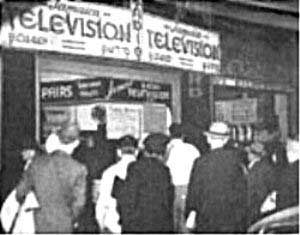
Since your piece
mentioned the crowds that gathered to witness a window display
of operating television sets I thought I would pass along an
aging photo of a 1944-1945 Jamaica Avenue audience enjoying
the “Friday Fight Nights” at the Jamaica arena.

|
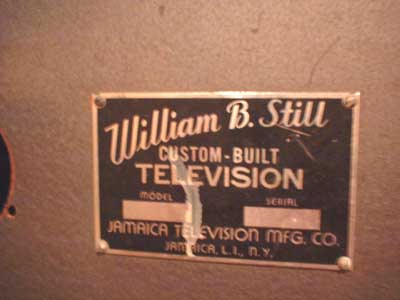
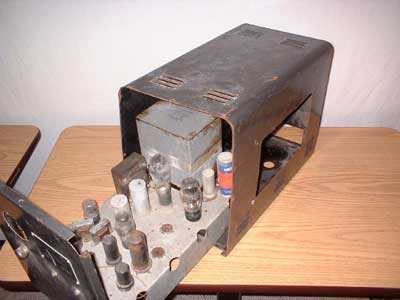
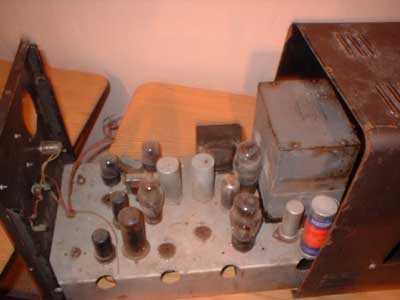
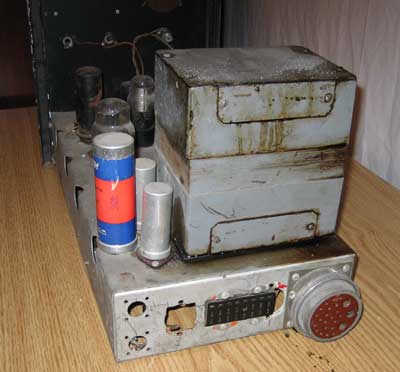
Recently the museum acquired a piece of equipment made
by Jamaica Television. The unit contains power supply circuitry,
including a very large transformer with a high current filament winding.
There are also tubes which are wired as amplifiers, perhaps for vertical
and horizontal drive signals The connector on the rear is the type used
on early RCA camera cables. It is likely that this was a power supply
for one of the cameras used by the station.


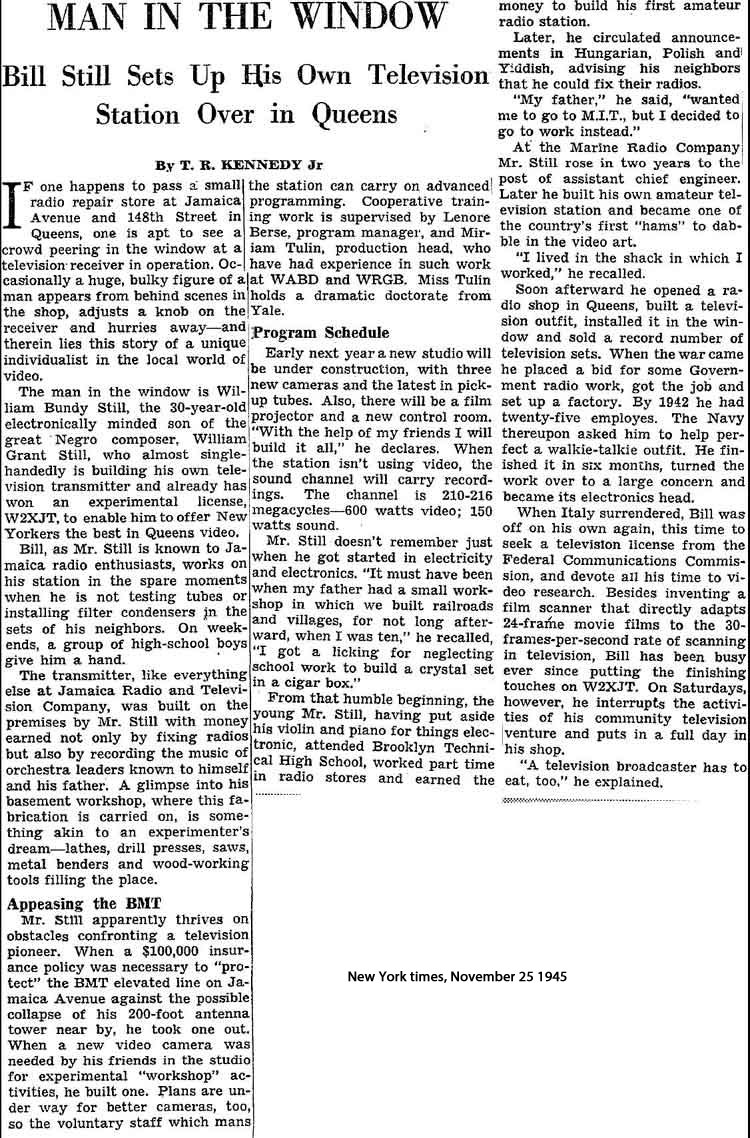
New York Times, November 25 1945
Courtesy of John Pinckney
|