
Mechanical Television Ulises Armand SanabriaThe following is from Peter Yanczer:
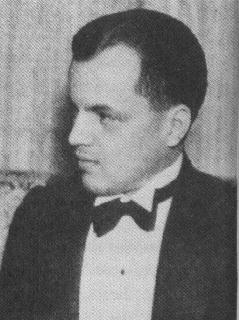
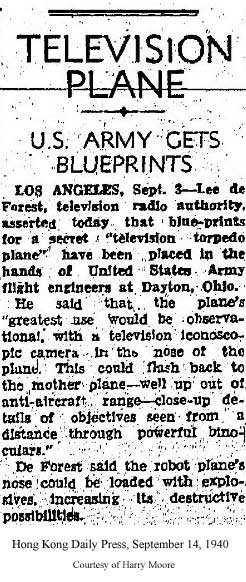
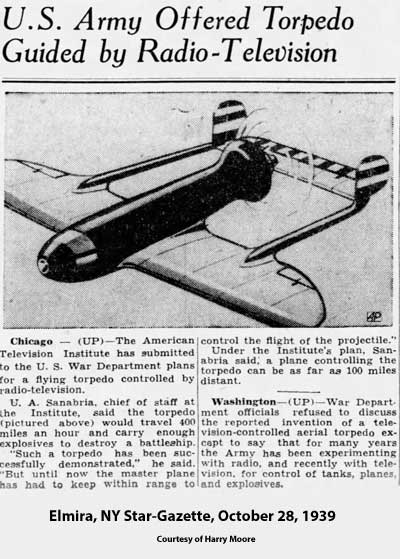
(1906-1969) Ulises Sanabria was born in southern Chicago on September 5, 1906. His parents were American and his grandparents were Spanish. He was raised and schooled in the Chicago area. He often said of his ancestry that it was so extremely mixed that he could best be described as "typically American". He was educated in the local Chicago schools and his "heroes" were Ericsson, Eli Whitney, Robert Fulton, Alexander Bell, Samuel Morse and most of all, Thomas Edison. He looked on Lee deForest as his contemporary, who was a generation ahead. Most of all, he wanted to be an inventor and do something big and important. He selected television, without the slightest idea of how he was going to go about it. When he was 15 years old, he told his one and only girl friend of high school days, that he was going to invent television. Two years later, he figured out how to do it. Two more years later, at the age of 19, he demonstrated the first television in Chicago. This was only four months after the first demonstration in history by C. F. Jenkins. (Note, Mr. Sanabria's work was independent of C. F. Jenkins). Mr.Sanabria was always very proud of the fact that he was one of the first three to invent television. During his last six months in high school, his main benefactor was W. R. Hearst, of newspaper fame. It seems that this was because television inventions had a special appeal to the publishers technical advisers. In 1926 through 1936, Ulises Sanabria with a budget of approximately $1,000,000, set up a laboratory in the Hearst building in downtown Chicago and there he supervised developmental research projects in television. He always felt that television could be a strong supplement to movies in theaters. Much of the research activity was therefore related to large screen television. Mr. Sanabria was self educated in the field of television, radio and electronics. During the course of the development work, he acquired a working knowledge of the tools for glass working, lens grinding, accurate machine work, electric generators, automatic machinery for glass working and became an expert trouble shooter in all types of electronic equipment. He was the first to produce television using interlaced scanning in January, 1926. He used a unique triple interlace method that was especially effective in reducing flicker in the picture. Later in that year, the Illinois Publishing & Printing Company supported him in successfully demonstrating television to 200,000 people attending the Chicago Radio Show from October 10th though 17th in the Chicago Coliseum. Some of the items developed early in the research work were, accurate mechanical scanning systems, large size potassium hydride photo cells, Long column neon light valves, wide range DC amplifiers, filtered arc light for elimination of commutator ripple in pictures, series modulation of transmitting oscillators. In later years, Mr. Sanabria gave consideration to increasing the number of lines to 48 and interlace 6 fields of 8 lines each. However, this idea never went past the "thought" stage because of other important improvements and advancements that would overshadow it. Mr. Sanabria was the builder and engineer of WCFL, the first television station in Chicago on June 12, 1928. By sending the sound signal to station WIBO and the picture on WCFL, he was the first to transmit sound and picture simultaneously on the same wave band. In May 19, 1929, he began building the television transmitter for W9XAO located at 6312 Broadway, built near the main WIBO studio on the second floor. A bank of forty-eight six inch diameter photo-electric cells were mounted in one wall of the studio, with a square hole in the center to pass the flying spot scanning beam. Station W9XAO was in operation in the summer of 1929 and by this time, Sanabria and his people were operating as the "Western Television Corp." with Clem F. Wade as president and Martin J. Wade as secretary. The Western Television Corp. was prepared to build commercial television transmitters using their unique interlaced scanning feature. Sanabria went on to supervise the construction of 24 stations using his system of scanning. Western Television was the first company to produce a commercial television receiver (The Visionette) in 1929 with a 17 inch scanning disk. It was available as kit for $88.25 minus the Kinolamp and cabinet. The cabinet was an extra $20.00. The Visionette cabinet contained only the scanning disk assembly. Separate receivers for sight and sound were necessary to make up a complete television receiver. A companion receiver and consolette table were available from Western Television for an additional $85.00 and $20.00 The scanning disk assembly of the kit, slightly reconfigured and with two 6 inch photocells and a light source, was also sold as a camera. In 1932, Western Television placed on the market their new table model 41 receiver under the Echophone brand name. Although there was no receiver for sound, it did include an eight tube superheterodyne receiver for the picture. The tuning range was from 1400 to 2850 kilocycles. For the sound, the Echophone model 14 or model 16 receivers were recommended. The television receiver featured a new eight inch diameter, 45 hole lens disk and a new type of hot cathode crater lamp developed by Lloyd P. Garner. When this receiver was available, there were 22 stations broadcasting the 45 line interlaced Sanabria signals. The model 41 sold for $85.00, complete with tubes. A chassis, very similar to the one in the model 41 was later used in the "Empire State" television receiver. The picture size on the model 41 was approximately 4 1/2 inches square, whereas on the Empire state, it was 8 inches square. The larger cabinet also provided space for a complete sound receiver and loudspeaker, mounted in the lower portion of the cabinet. Mr. Sanabria was also creating interest in television amongst the public, by providing demonstrations of large screen television in auditoriums and theaters throughout the United States and Canada. Some of the places where these took place include: Macy's, New York,,, Abraham & Strauss, Brooklyn,,, Bamberger's Newark, New Jersey,,, Hoschild-Kohn & Co., Baltimore,,, Litt Bros., Philadelphia,,, Spear & Company, Pittsburg,,, Edwards & Sons, Schenectady,,, Sears Roebuck, Rochester,,, Pizitz, Burmingham, Alabama,,, May Company, Cleveland,,, O'Neil & Co., Akron, Ohio,,, R. H. Block, Indianapolis,,, Sears Roebuck, Chicago,,, Marshall Field Co., Chicago,,,Boston Store, Milwaukee,,, Golden Rule, St.Paul,,, Stix, Baer & Fuller, St. Louis,,, Crowley-Milner, Detroit,,, Poeple's Outfitting Co., Detroit,,, May Company, Los Angeles,,, Eporium, San Francisco,,, Meyer & Frank, Portland, Oregon,,, Brandels & Co., Omaha,,, Gimbles, Miwaukee, Easton's Stores, Canada,,, Garrick Theater, Chicago,,, The Century of Progress Exposition. Other cities where demonstrations were given include: Midland and Hamilton, Ontario,,, Medicine Hat, Alberta and Vancouver, British Columbia,,, Seattle, Washington, Des Moines, Holdridge and Lincoln, Nebraska,,,Witchita, Kansas. Nashville, Tennesee,,, Reading and Scranton, Pennsyvania,,, Providence, Rhode Island,,, Boston, Massachusetts,,, Cincinnati, Ohio. Each and every demonstration of large screen television was attended thousands of people. Depending on the size of the room, the picture was either 6 1/2 feet or 10 feet square. The receiver equipment was generally placed on a eight foot high stand. The scanning disk was 45 inches in diameter and two inches thick. It was made of cast aluminum and has 45 three inch diameter lenses located in three sectors. It weighed 120 pounds and was put in place or removed using a block and tackle. On one occasion, after a show in Baltimore, the rope broke as the disk was about to be removed. It fell to the floor with a great crash and broke into pieces. Most of the 45 lenses were broken also. The disk was useless and had to be replaced. The next show was in 2 days, in New York and the replacement disk was in Chicago. Needless to say; for the next show, the equipment was ready. As they say, "the show must go on"!---and it did! By 1934, with further improvements in his equipment, Ulises Sanabria was able to demonstrate pictures that were 30 feet wide. It is interesting to note that with all of the Sanabria stations that were operating and his strong interest in showing television pictures in existing movie theaters, he was never able to show a movie film of any kind using the Sanabria triple interlace system. Although one of his engineers, Armando Conto had in fact developed a means of using motion picture films with the triple interlace system, It was totally impractical because of its complexity and associated problems. For example, it required two sets of identical films of the subject matter, operating in separate synchronized projection systems, while both films were being scanned by a common scanning disk. Only alternate frames on each film were actually scanned. Sanabria never presented even a cartoon film in any of his demonstrations and neither did any of the other stations he had set up. At first this was not a serious problem, but in later years it became one. In the years before World War II, Mr. Sanabria formed and was the principal stockholder and president of American Television, a four year national correspondence school and a four year residence school in Chicago, Detroit and Los Angeles. Doctor Lee De Forest was a consultant to Mr. Sanabria and the school. They were in the process of setting up another branch in New York on Pearl Harbor Day. During the war years, 2000 of their students were recruited by our armed forces. The school had 6000 men in four year training courses, in which they were granted the first Bachelor of Science Degrees in Television. Sanabria designed a "television torpedo plane" for use by the military in 1939
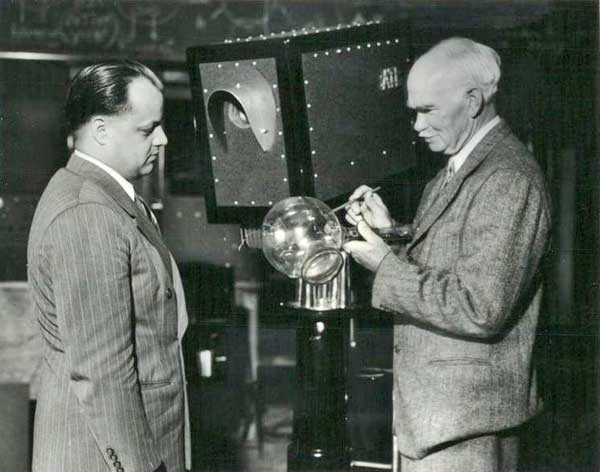
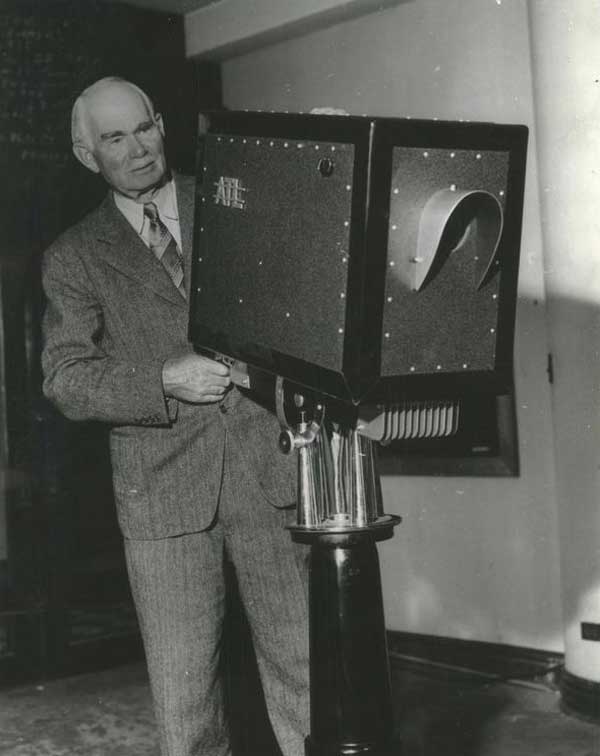
Sanabria (L) and Lee DeForest with an Iconoscope and camera
Lee DeForest and the camera During the war, the Signal Corps appealed to Mr. Sanabria to make cathode ray tubes, which they already were doing in a small way. As part of the training, the school had the students building both cathode ray tubes and monoscopes which the students used in their laboratory projects. Mr. Sanabria determined they could produce about 50 tubes a day, as a start. In a short while this was stepped up to 1000 a day of all types and sizes. In December, 1948 production began on the 10 inch round picture tubes, By May, 1949 they were producing 500 a day. The glass was supplied by Corning Glass Works and half of the finished tubes went to Westinghouse, the other half to Tung-sol. Tube sizes increased rapidly and by December, 1949 they were making their first 16 inch rectangular tubes. In 1950, Mr. Sanabria went into the production of television sets under his name and opened self-owned stores to sell them throughout the United States. He was producing 1000 sets a week. He built the cabinets, the picture tubes and the entire chassis. He also went into military research and development and was manufacturing image storage tubes, hydrogen thyratrons and the test equipment to evaluate them. These activities were expanding all at once and no provision had been made for the proper banking procedures, so all of the enterprises became co-mingled financially. This resulted in prohibitive taxes and military refunds, so that even in his most successful years through 1955, Mr. Sanabria ended up with overburdening liabilities to the Excise Tax Division of the IRS and the Fiscal Divisions of the Armed Services. He never recovered from these losses.
|