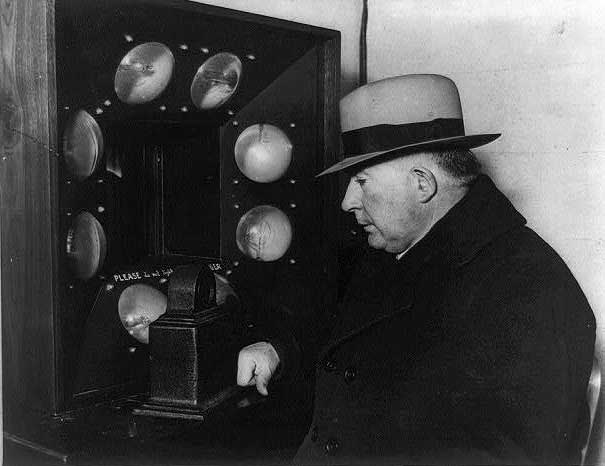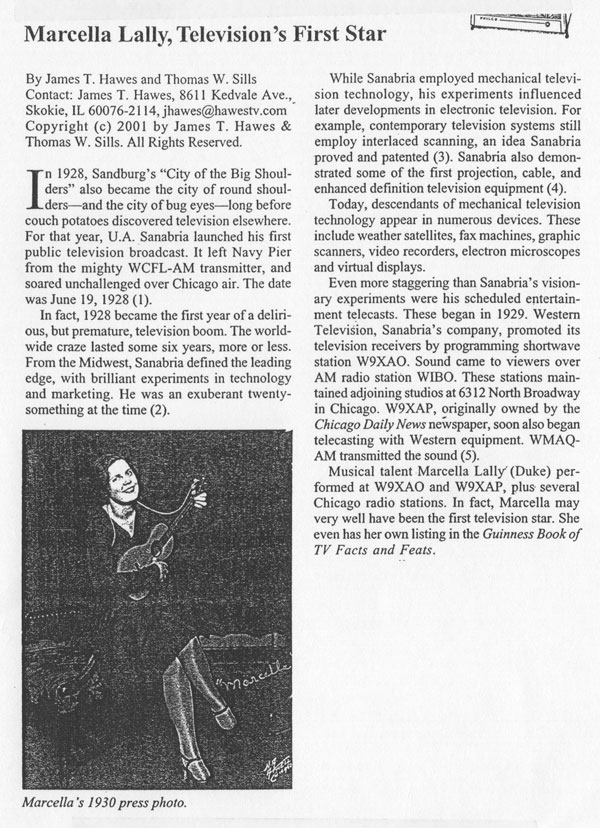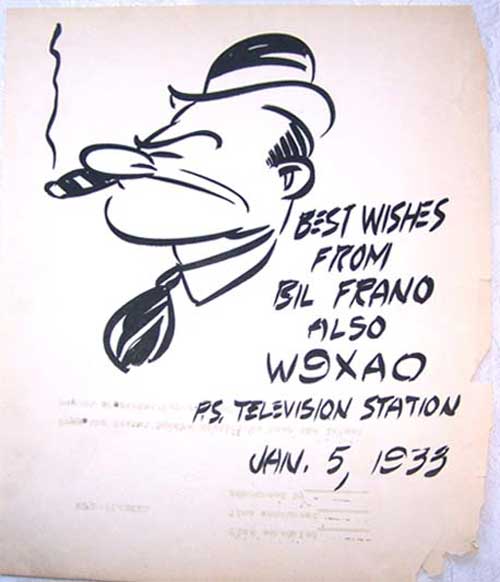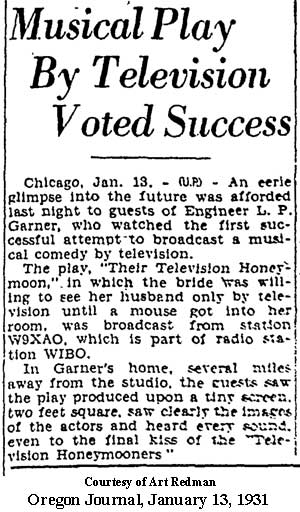

Mechanical Television W9XAO ChicagoU. A. Sanabria was the builder and engineer of W9XAA, the first television station in Chicago, which went on the air on June 12, 1928. By sending the sound signal to station WIBO and the picture on WCFL, he was the first to transmit sound and picture simultaneously on the same wave band. In May 19, 1929, he began building the television transmitter for W9XAO located at 6312 Broadway, built near the main WIBO studio on the second floor. A bank of forty-eight six inch diameter photo-electric cells were mounted in one wall of the studio, with a square hole in the center to pass the flying spot scanning beam. Station W9XAO was in operation in the summer of 1929 and by this time, Sanabria and his people were operating as the "Western Television Corp." with Clem F. Wade as president and Martin J. Wade as secretary. The Western Television Corp. was prepared to build commercial television transmitters using their unique interlaced scanning feature. Sanabria went on to supervise the construction of 24 stations using his system of scanning. Initially, a small television studio was built near the main WIBO studio on the second floor. A bank of photocells was mounted in the wall of the studio with a hole in the middle for the entrance of the flying spot scanning beam. The light source was a Peerless reflector arc lamp such as was used in movie houses. The scanning disc had 45 tiny holes arranged in three interlaced spirals, and was mounted directly on the shaft of a 900 rpm synchronous motor so as to scan at 15 frames a second. A similar interlacing scheme was later used in electronic television to allow slower scanning without flicker. A projection lens in front of the disc magnified the approximately one inch square field at the disc to about two feet square at the location of the performer in the studio. Lenses of different focal lengths could be used to produce scan fields up to 10 feet square. As the flying spot moved rapidly across the performer, light was reflected back to the photo cells and converted into corresponding electrical signals. A row of automobile storage batteries was connected across the dc supply for the arc lamp to smooth out fluctuations at the light source. The transmitter, located on the top floor, consisted of a pair of UV204, 250 watt tubes as oscillators, which were isolated from electrical ground. The antenna was on the roof. An unusual modulation scheme known as "series modulation" consisted of several UV204 tubes connected in parallel. Their cathodes were at ground potential and their anodes were connected to the cathodes of the oscillator tubes. A motor generator supplied the necessary 2000 vdc. Experimental television broadcasts from this small studio were mostly head-and-shoulders shots. Some of the programs used the audio channel of WIBO. Several movie stars posed including Don Ameche. The number of television receivers was very limited. (Information from article written by William N. Parker in 1984). For more information, see Chicago Television History.
|