
Early Color Television CBS Field Sequential System (US, 1940-1953)
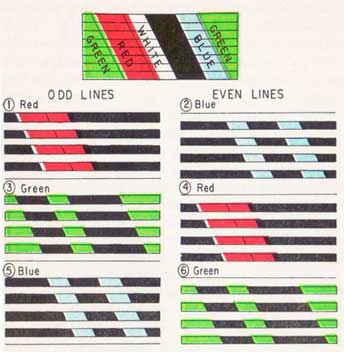
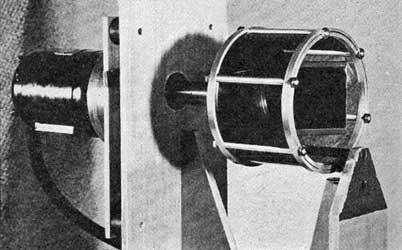
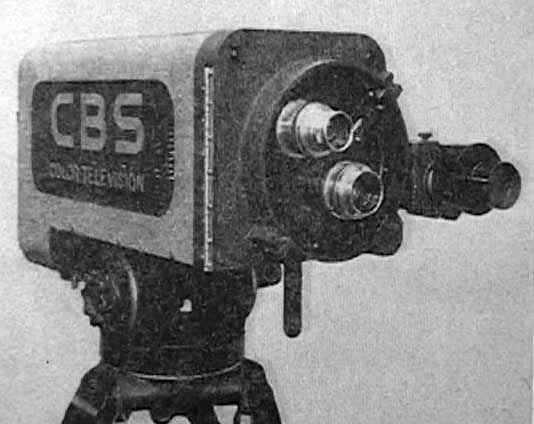
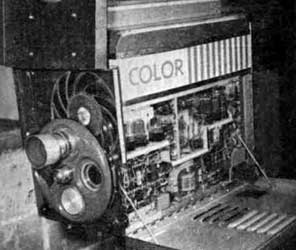
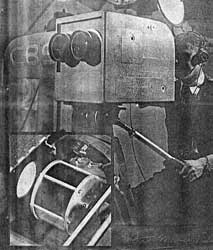
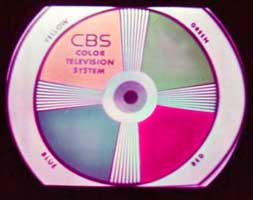
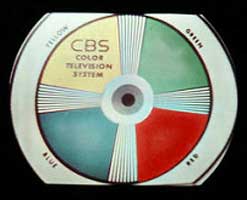
This field sequential system displayed red, green, and blue television images in sequences, and depended upon the retentivity of the eye to merge these into a single color picture. If, however, flicker and picture sharpness were to be maintained at the level of monochrome television, a field sequential broadcast signal would require three times the bandwidth of monochrome. A compromise or trade off was reached by increasing the bandwidth from 4 to 5 MHz, number of frames were reduced from 30 to 20 per second, and scanning lines reduced from 525 to 343. For this reason it was incompatible with existing black and white broadcasting. This was a hybrid system. It used a rotating disk, but it was not a scanning disk; it contained red, green, and blue filters arranged in radial arcs. The "color wheel" spun in front of a conventional electronic scanning tube, presenting it with successive red, green, and blue images. The receiver had a similar color wheel, displaying the successive images to reconstruct the full color image. The chart below shows how the color bands were scanned and recombined on the CBS system to form all hues, black, and white in the full color picture. (Information and pictures courtesy of Rick Plummer)
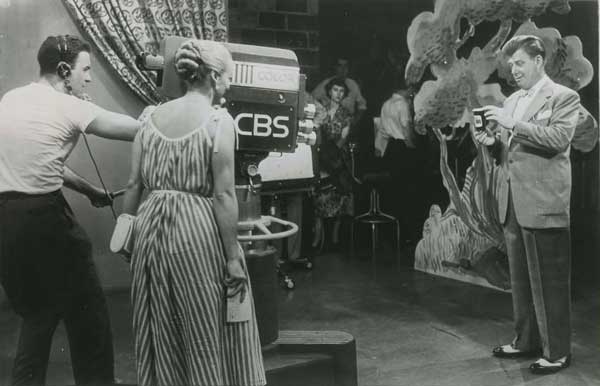
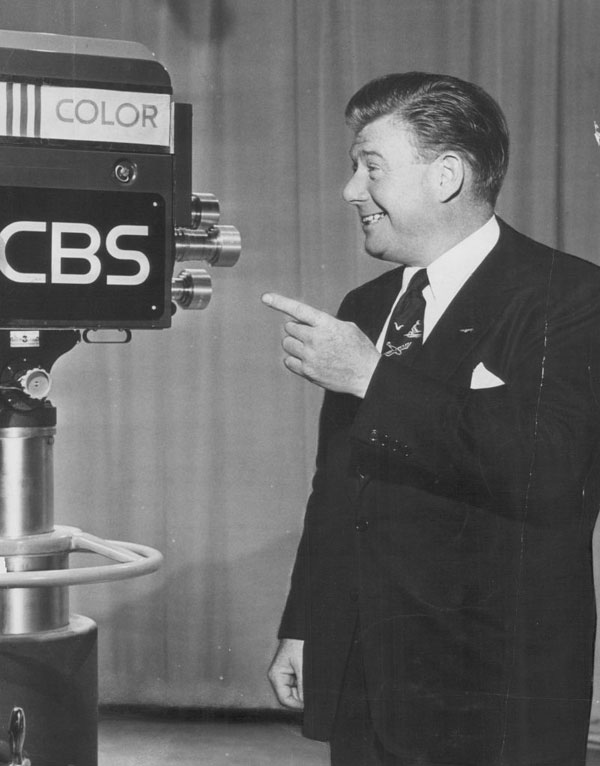
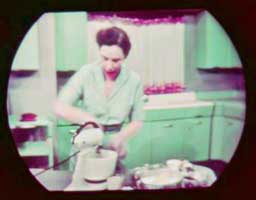
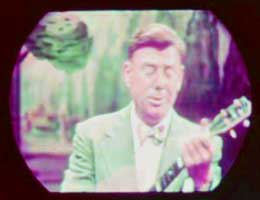
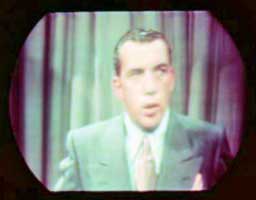
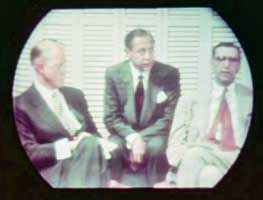
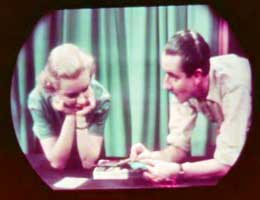
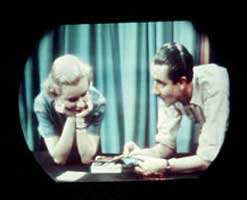
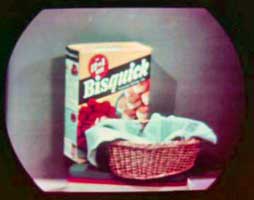
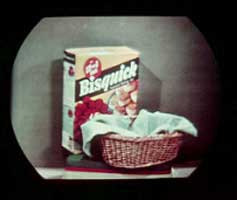
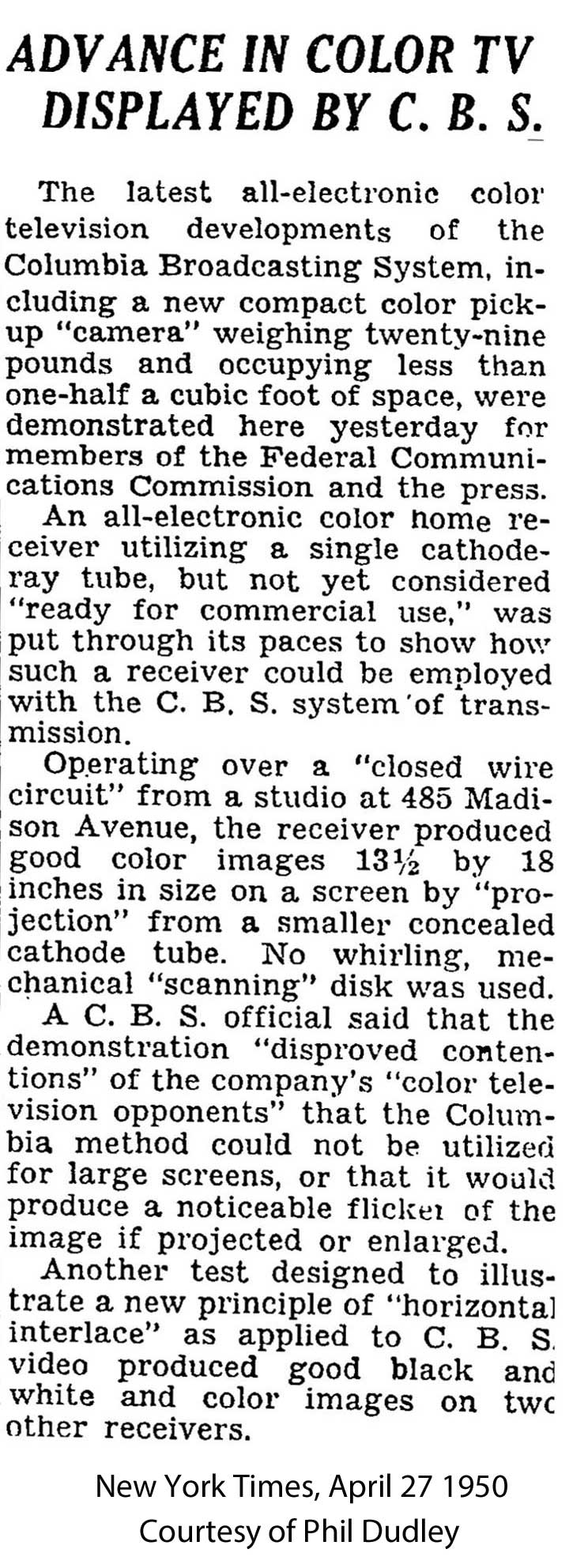
CBS arranged demonstrations of their color system for NTSC members and FCC officials on 28 August and 4 September 1940. They were shown beautiful color imagery with 343 lines of resolution on a TV screen 18 centimeters wide, operating at CBS labs in New York City. The audience found it impressive. FCC Chairman Fly was enthusiastic enough to declare: "If we can start television off as a color proposition, instead of a black and white show, it will have a greater acceptance with the public." An RCA representative on the NTSC replied that his company was aware of and unimpressed by the CBS system, and called it a "mechanical system". RCA's technology was the leader in the current race to establish TV standards, and the company was not happy at a CBS effort to muddy the waters. Their 1949 Color System was the third field sequential approach to be proposed to the FCC for adoption. They had suggested that their field sequential standards be adopted in 1941 and 1946. At those earlier times, with few black and white receivers in the hands of the public, the adoption of the non-compatible CBS system might have been feasible. In 1945, Federal Telephone and Radio Corp. built a UHF transmitter for testing of the CBS system. In 1950 the FCC approved the CBS system over the RCA compatible approach, mainly because the picture quality was superior. In April of 1950 CBS demonstrated an all-electronic version of their system to counter concerns that it was a strictly mechanical system. In 1951 CBS began test broadcasting, using a field-sequential system of 405 lines, 144 fields per second, incompatible with the NTSC black-and-white standard. The first network broadcast of the CBS system featured Arthur Godfrey and Faye Emerson, and was shown on June 25, 1951, from 4:30 to 5:30 PM:
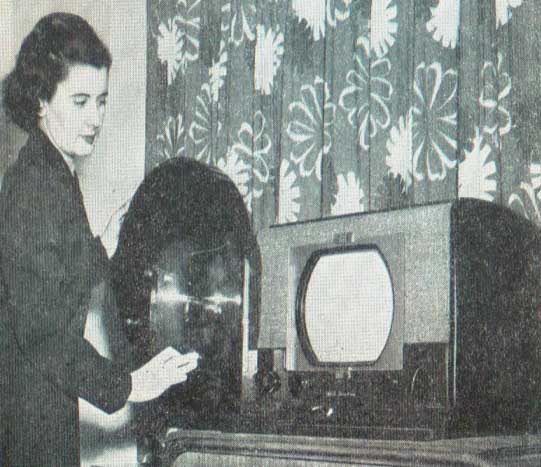
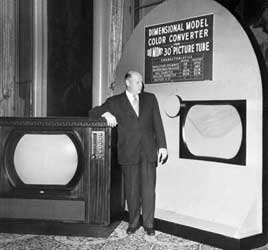
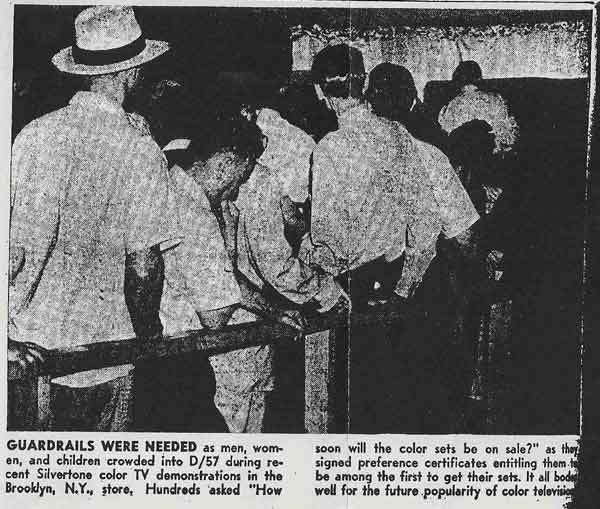
Several local TV stations broadcast the color programs, including WNAC Boston, WCAU Philadelphia, WMAR Baltimore. In Ohio, WEWS in Cleveland, WHIO in Dayton and WKRC in Cincinnati all took part in these early CBS color broadcasts. In Cincinnati and Dayton, CBS color was demonstrated in Kroger grocery stores, and in Cleveland, the demonstrations were at a Sears store. A few receivers were manufactured for the CBS system, including models made by CBS, Sears-Silvertone and Zenith. Converters were sold to turn a black and white set in color. Some people made their own converters. Due to the Korean War, CBS stopped color broadcasting 4 months later. CBS also developed an all electronic color TV system which was a projector type having the equivalent of a 22 inch screen. Three images were produced on the face of the tube and these were combined optically. In late 1953, with the adoption of the NTSC system, CBS introduced its Chromacoder system, which used a field sequential camera and equipment to convert to NTSC. For a more detailed history of CBS color, see Bob Cooper's article. Extensive information on early color systems can be found at Ed Reitan's site. Dave Johnson wrote an article about Peter Goldmark, CBS's chief engineer and inventor of the CBS field sequential system. The museum has a working Gray Research field sequential color monitor and a converter designed for the CBS system. Here are newspaper and magazine articles and advertisements related to the CBS system.
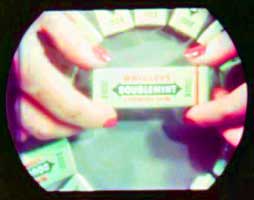
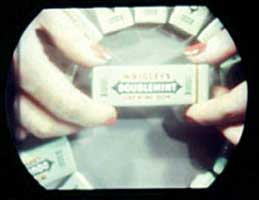
From 1951 CBS broadcast (Courtesy of Life Magazine)
|
|||||||||||||||||||||||||